Author’s practical guidance

Resentment about their free time

Source named in the book: coparenting research (Feinberg) · Gottman Institute

The arithmetic stays invisible until somebody counts it.

Say this now

Option 1
“I need two hours on Saturday, out of the house. Which two?”

Ask for specific time, not for understanding. Understanding does not produce hours.

Option 2
“I'm not counting to punish you. I'm counting because I lost track of myself.”

Names the motive, so the conversation does not become about scorekeeping.

Do this

  • Count one ordinary week honestly, both of you, before the conversation.
  • Ask for time in the calendar, not in principle. A booked hour exists; an agreed hour does not.
  • Make it recurring, so it does not need renegotiating every week.
  • Take it even when you feel you have not earned it. Especially then.
  • Give the other person theirs without being asked.

Avoid this

  • Sighing loudly and waiting to be asked.
  • "Must be nice" — the sentence that starts a fight and settles nothing.
  • Keeping a private ledger and producing it during an argument.
If it repeats

Unequal free time is structural, and it does not resolve by being understood. If the two-hour conversation has happened three times without changing the calendar, the calendar is the thing to change.

Why the book suggests this

The arithmetic stays invisible until somebody counts it. One of you goes for a run on Saturday morning; the other has not been alone in a room since March. Nobody decided this. It accumulated an hour at a time, and every individual hour was reasonable.

Resentment is what a fair-minded person feels about an unfair split they have not yet named. It grows quietly, because saying it out loud sounds petty next to the size of the feeling.

From this collection

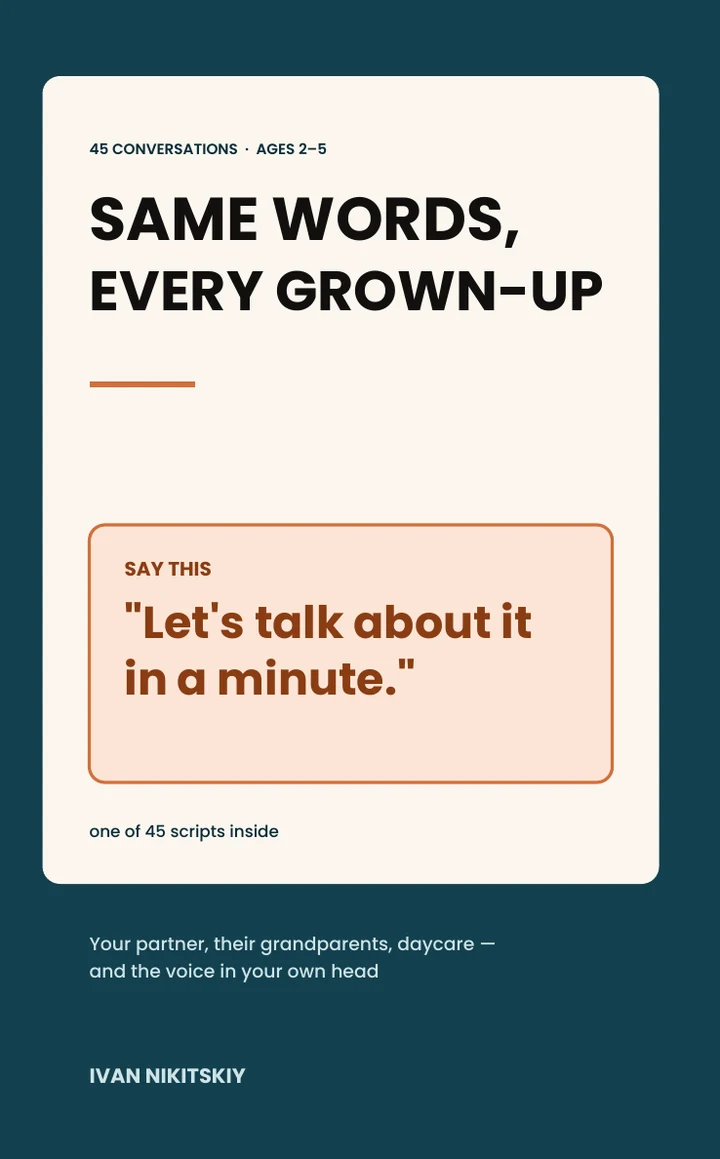
Same Words: Every Grown-Up

45 prepared situations in this family area.