Author’s practical guidance

Your child said something embarrassing out loud

Source named in the book: Positive Discipline (Nelsen) · Emotion coaching (Gottman)

Small children have no filter and perfect recall for exactly the wrong sentence.

Say this now

Option 1
(lightly, to the adult) "Small people, big ears."

A short line that acknowledges without confirming, and lets everybody move on.

Option 2
(to your child, later) "Some things we say only at home."

A rule, not a scolding. They will need it repeated for years.

Do this

  • Don't react in the moment beyond one light sentence.
  • Don't correct the child publicly. It doubles the audience's attention.
  • Say the rule at home, once, in one sentence.
  • Watch what gets said in front of them for a week. That is the actual fix.
  • Let it go faster than feels natural. Everybody else already has.

Avoid this

  • Telling your child off for repeating what you said. You said it.
  • Elaborate denial, which makes it look true.
  • Explaining at length to the person who heard.
If it repeats

If it keeps happening on the same subject, the child is repeating something they hear often. That is worth noticing rather more than the embarrassment is.

Why the book suggests this

Small children have no filter and perfect recall for exactly the wrong sentence. They repeat what they heard, at volume, to the person it was about, and they do it in line at a store.

The embarrassment is real and the damage is almost always smaller than it feels. Adults understand that three-year-olds repeat things. What they remember afterwards is not the sentence — it is how you handled the ten seconds after it.

From this collection

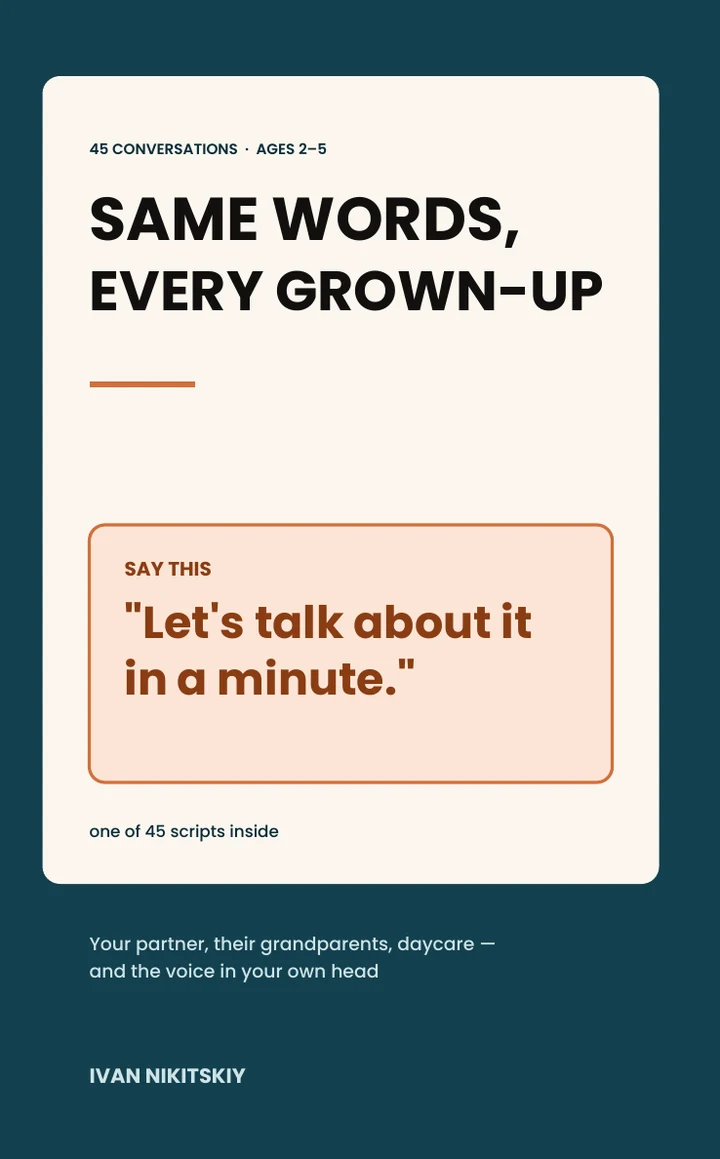
Same Words: Every Grown-Up

45 prepared situations in this family area.