Author’s practical guidance

Throwing and breaking things when angry

Source named in the book: Emotion coaching (Gottman)

Big anger needs a body exit.

Say this now

Option 1
“Blocks are not for throwing. Pillows are.”

Refuse the object and offer the substitute in one breath.

Option 2
“You're allowed to be angry. You're not allowed to break things.”

Two separate permissions. Children hear the difference.

Do this

  • Redirect the body: stomp, push the wall, throw a pillow, squeeze a cushion.
  • Move the fragile things out of reach rather than relying on self-control that is not there yet.
  • Once calm, repair it together — pick things up side by side, no shaming.
  • Keep the consequence natural: the broken toy stays broken.
  • Say nothing more about it afterwards.

Avoid this

  • "You're so bad!" — attaches a character to a moment.
  • Long lectures about the broken toy while they are still furious.
  • Replacing it immediately, which removes the consequence entirely.
If it repeats

Build an anger corner they helped choose: cushions, a basket of soft things to throw, a picture of the breathing. Teach it in calm moments — a tool introduced during the storm is never used.

Why the book suggests this

Big anger needs a body exit. It arrives as physical energy — hot hands, fast breathing, a need to push — and without somewhere to go it goes into whatever is being held.

This is also where adults escalate, because a broken object feels like a line crossed. But a lecture delivered to a furious three-year-old lands nowhere, and the repair conversation only works once the body has come down.

Related prepared situations

What happened next?

From this collection

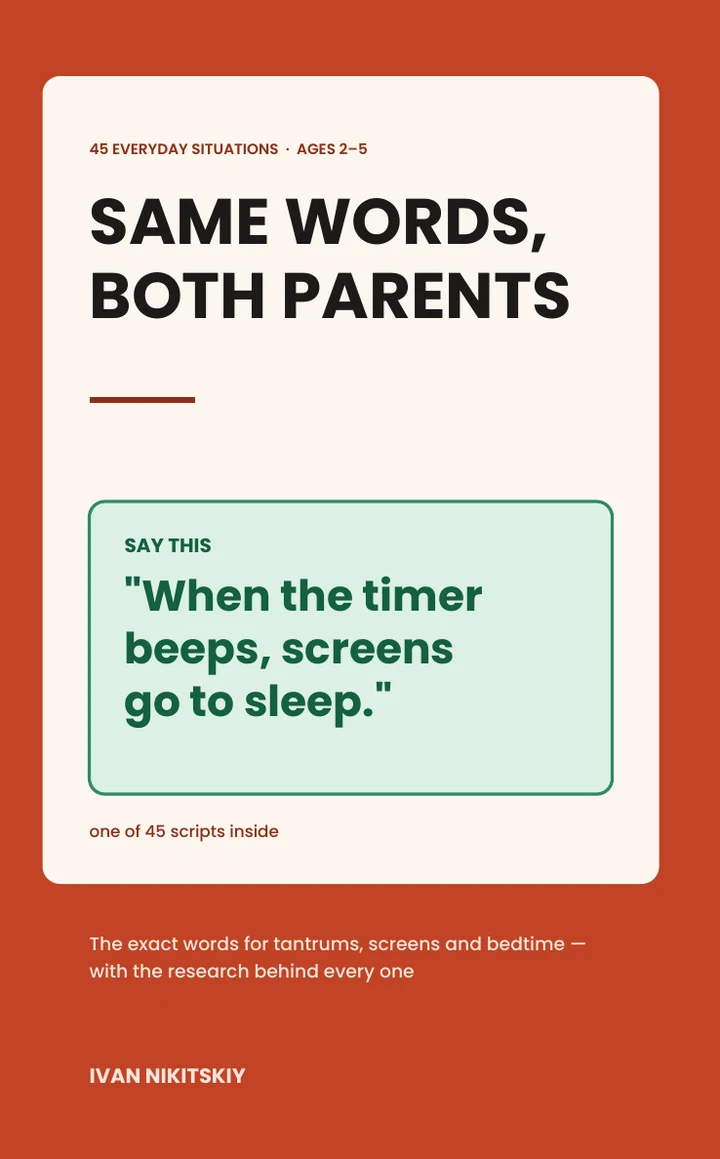
Same Words: Both Parents

45 prepared situations in this family area.