
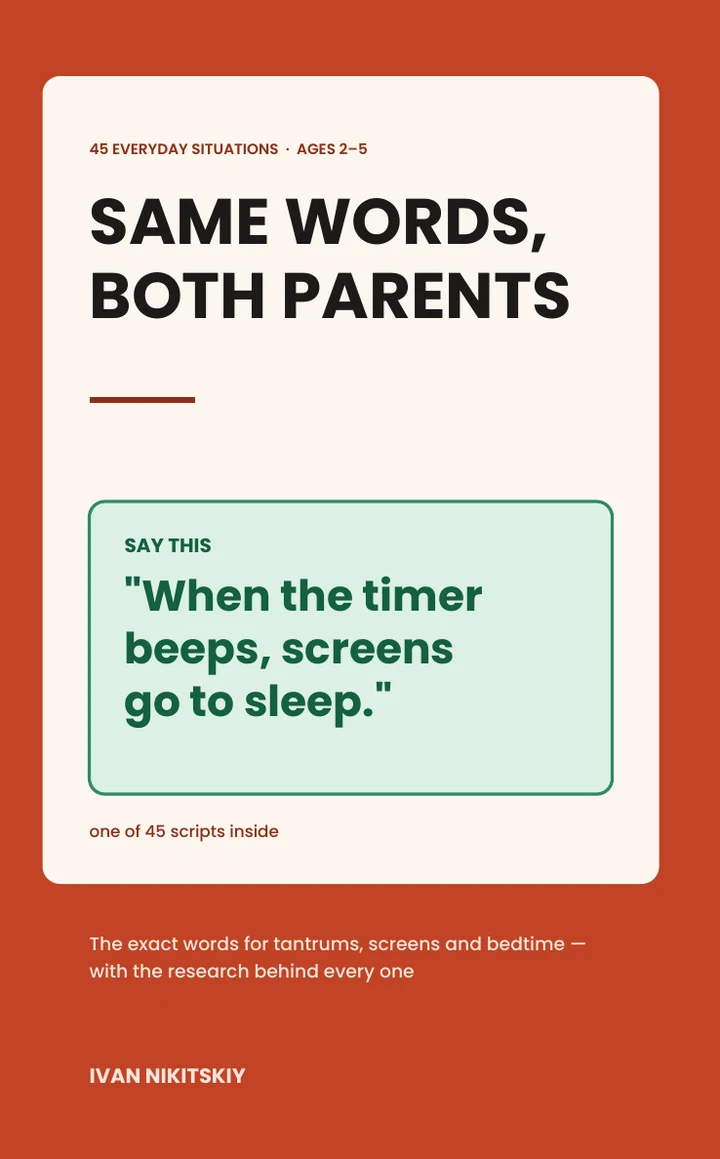
Same Words book
Both Parents
Shared language for meltdowns, routines, sleep, food, conflict and everyday outings.
View the book on Amazon ↗45 situations covered in this book
My toddler has a meltdown on the floorBoth Parents · MeltdownsA child is on the floor in a full meltdown, and ordinary conversation has disappeared from the moment. The intensity draws every eye and leaves the adults standing inside a scene that no longer feels manageable or private.→My child has a tantrum when I say noBoth Parents · MeltdownsOne limit has been set, and the answer is followed by a tantrum. The original request remains simple, but the family moment is now filled with protest, strong feelings, and the weight of that single refusal.→Car seat battleBoth Parents · MeltdownsThe child does not want to get into the car seat, and the trip cannot begin without it. Buckles, straps, and the waiting car turn a routine departure into a determined struggle.→My child hits me during a meltdownBoth Parents · MeltdownsA meltdown is already underway when the child begins hitting the adult beside them. The moment now holds both an intense emotional outburst and physical contact that cannot simply be ignored.→The after-daycare meltdownBoth Parents · MeltdownsThe child makes it through daycare, then falls apart after coming home. The end of the childcare day brings a sudden, intense meltdown just as the family is trying to reconnect and move into evening.→Scary tantrums — when to seek helpBoth Parents · MeltdownsSome tantrums feel different from the difficult outbursts a family usually knows. Their intensity, duration, or pattern leaves the adults frightened and wondering whether this moment belongs in a conversation with a professional.→My child will not leave the playgroundBoth Parents · TransitionsPlaytime is ending, but the child still wants to play. The walk toward the exit becomes its own family moment, caught between the fun that is happening now and the next part of the day.→My child gets upset when I turn off the tabletBoth Parents · TransitionsThe tablet is switched off while the child still wants to use it. A clear end to screen time becomes a difficult transition, with the next part of the day waiting beyond an activity that felt unfinished.→Getting out the door in the morningBoth Parents · TransitionsMorning has a deadline, but the child is not moving toward the door. Clothes, shoes, bags, and one last distraction crowd the time before the family needs to leave the house.→Leaving grandma's or ending a playdateBoth Parents · TransitionsA visit with Grandma or a playdate has reached its end, while the child still wants it to continue. Goodbye becomes the hardest part of an otherwise happy time away from home.→Getting out of the bathBoth Parents · TransitionsThe bath is finished, yet the child does not want to climb out. Warm water and ongoing play have to give way to towels, pajamas, and a transition neither feels ready to make.→The transition formula that works anywhereBoth Parents · TransitionsOne activity is ending and another must begin, in a transition that could happen almost anywhere. The child remains focused on what is stopping while the adult is already thinking about what comes next.→My child keeps asking for one more thing at bedtimeBoth Parents · SleepBedtime keeps gaining another request: one more book, another drink of water, or one last small thing. The child stays engaged at the edge of sleep while the evening stretches beyond its expected ending.→My child will not let me leave the room at bedtimeBoth Parents · SleepThe bedtime routine is complete, but the child will not let the adult leave the room. The doorway becomes a dividing line between staying close and beginning the part of the night spent apart.→My child keeps getting out of bedBoth Parents · SleepThe child has been put to bed, then appears again, and then returns once more. Each trip out of the bedroom restarts a bedtime that everyone thought had already ended.→Waking at night and wandering the houseBoth Parents · SleepDuring the night, the child wakes and begins moving through the house. Bedrooms are dark, the family should be asleep, and an unexpected small figure is awake beyond their own room.→The 5 a.m. wake-upBoth Parents · SleepThe child wakes at five in the morning, ready to begin while the rest of the household still considers it nighttime. The day arrives hours earlier than the adults expected or wanted.→My child refuses dinner, then asks for snacksBoth Parents · FoodDinner is refused, but requests for snacks begin soon afterward. The same child who would not eat the meal is now hungry for something else, bringing food back into the evening on different terms.→"I don't like it!" — food they loved yesterdayBoth Parents · FoodA familiar food that was welcome yesterday is rejected today with complete certainty. The plate looks the same to the adult, while the child's response makes it seem entirely new.→Throwing food from the tableBoth Parents · FoodFood leaves the plate and lands beyond the table while the meal is still happening. Eating together becomes mixed with dropping or throwing, and everyone nearby is watching where the next piece will go.→Getting dressed — or "I do it MYSELF!"Both Parents · Getting readyGetting dressed slows down when the child insists on doing every part alone. Sleeves, fasteners, and time all become part of a morning caught between growing independence and the need to get ready.→My child refuses to brush their teethBoth Parents · Getting readyThe toothbrush is ready, but the child refuses to brush their teeth. A short daily task becomes a standoff in the bathroom, with bedtime or the morning routine waiting behind it.→Bath time and washing hairBoth Parents · Getting readyBath time reaches the part involving wet hair, water near the face, and washing. What began as time in the tub changes when the child's head and hair become the focus.→Refusing the pottyBoth Parents · Getting readyThe potty is available, but the child does not want to use it. A basic part of getting ready becomes a repeated point of refusal, with the rest of the routine waiting nearby.→My child resists haircuts and nail cuttingBoth Parents · Getting readyA haircut or nail trim brings a child close to unfamiliar tools, sounds, and careful adult hands. The ordinary grooming task feels delicate before the first strand or nail is even cut.→Giving medicineBoth Parents · Getting readyMedicine is needed, but the child does not want to take it. The small dose, its taste, and the adult holding it create a moment that cannot be treated like an optional snack.→My child hits or pushes other childrenBoth Parents · With other kidsPlay with other children turns physical when one child hits or pushes another. The shared activity stops abruptly, and several children and adults are now part of the same charged moment.→My child bites other children during playBoth Parents · With other kidsA child bites during time with other children. The action is sudden, the other child is hurt or startled, and the adults have to face a play situation that changed in an instant.→My child grabs toys and will not shareBoth Parents · With other kidsAnother child reaches for a toy, but the child holds on or grabs it back. Shared play narrows around one object, with both children wanting control of the same thing at once.→Throwing and breaking things when angryBoth Parents · With other kidsAnger moves into the child's hands, and objects are thrown or broken. The original upset is still present, but now the room also contains flying things, damage, and startled people.→A new baby in the houseBoth Parents · With other kidsA new baby is now part of the household, changing familiar rooms, routines, and attention. The older child is meeting family life with someone new in the place that used to feel entirely known.→My child says no to everythingBoth Parents · Power strugglesEvery request seems to meet the same immediate answer: no. Dressing, leaving, eating, and small everyday choices all become fresh places for the child to resist what an adult has asked.→The endless "why?"Both Parents · Power strugglesOne answer leads directly to another question, and then another. The child's repeated why follows the adult through an everyday conversation that never seems to reach a final explanation or resting place.→The endless whiningBoth Parents · Power strugglesThe request is repeated in a drawn-out, unhappy voice that fills the room. What the child wants may be simple, but the sound of asking has become the hardest part for the adult.→Pretending not to hear youBoth Parents · Power strugglesThe adult speaks, but the child continues as though nothing was said. A request hangs unanswered while play or another activity carries on, creating uncertainty about whether the words were heard.→"Mama? Mama? MAMA!" — interruptingBoth Parents · Power strugglesThe child calls for Mama again and again while she is speaking or doing something else. Each interruption presses into the conversation, making it hard for either the adult or child to wait.→Refusing to tidy upBoth Parents · Power strugglesPlay is over, but the toys remain across the room and the child refuses to tidy them. The enjoyable part has ended, leaving a final shared task that nobody wants to begin.→Teach calming BEFORE the stormBoth Parents · Big feelingsCalm parts of the day offer a very different setting from a storm of big feelings. The family is between difficult moments, with space to think about what calm itself looks and feels like.→The ten minutes that prevent meltdownsBoth Parents · Big feelingsA short stretch of attention sits between one part of family life and the next. These ten minutes are not a crisis, but they belong near the times when difficult feelings often arrive.→Catching it before the point of no returnBoth Parents · Big feelingsThe child's feelings are rising, and the adult recognizes that the moment is nearing a point where ordinary conversation disappears. Nothing has fully broken open yet, but the shift is already visible.→"I hate you!"Both Parents · Big feelingsIn the middle of strong feelings, the child tells the adult they hate them. A few sharp words suddenly carry the weight of the whole conflict and stay in the room after they are spoken.→My child has tantrums in shops or restaurantsBoth Parents · Out and aboutA tantrum unfolds in a store or restaurant, surrounded by strangers and public noise. The family is managing a private kind of distress in a place where other people can see and hear everything.→"I want it!" — demanding at the storeBoth Parents · Out and aboutA child spots something in a store and demands to have it. The wanted object is close enough to see or touch, while the adult and child are still in the middle of shopping.→Running off — won't hold handsBoth Parents · Out and aboutOut in public, the child runs away or refuses to hold an adult's hand. Movement that feels playful to the child becomes an urgent family moment beside streets, crowds, or open space.→Waiting — lines, restaurants, waiting roomsBoth Parents · Out and aboutThe child has to wait in a line, restaurant, or waiting room where nothing happens quickly. Time slows down, movement is limited, and the next interesting thing belongs to an uncertain later.→