Author’s practical guidance

Turning off the tablet

Source named in the book: Positive Discipline (Nelsen) · Faber & King

Screens are built without endings.

Say this now

Option 1
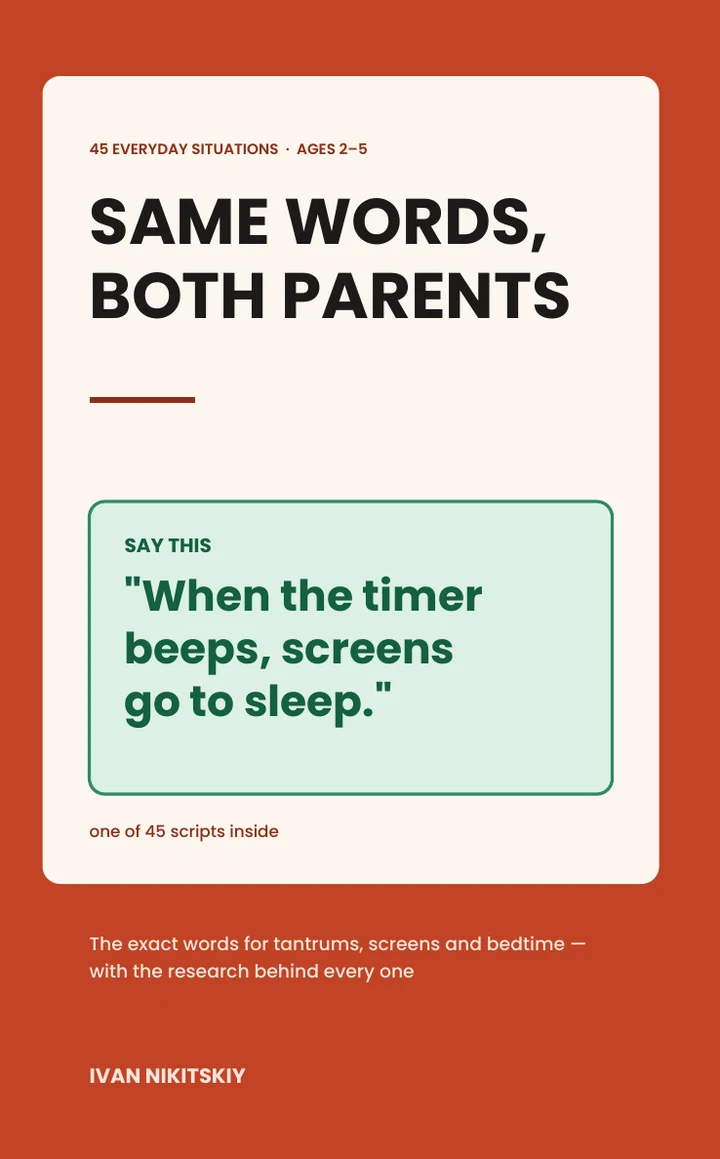
“When the timer beeps, screens go to sleep. The timer decides, not me.”

Hand the authority to an object. You cannot argue with a timer, and neither can they.

Option 2
“You're mad the show ended. That's fair. It's still done.”

Agree with the anger. Do not reopen the decision.

Do this

  • Set a visible timer BEFORE the tablet comes on, not after.
  • End on a natural boundary — end of episode, end of level — never mid-action.
  • Have the next thing ready so the ending is a landing, not a hole.
  • Let them press stop themselves when they are able to.
  • Keep the rule identical every day. This is the one that decides whether any of it works.

Avoid this

  • "Last video, I mean it" — said four times, and meaning nothing by the second.
  • Turning it off mid-episode with no warning at all.
  • Using the tablet as a reward and removing it as a punishment — it makes the screen the most important object in the house.
If it repeats

Negotiating once resets the whole rule — a child who got five extra minutes on Tuesday will ask for them daily for two weeks. If the ending is a battle every single time, the sessions are probably too long rather than too frequent.

Why the book suggests this

Screens are built without endings. An episode rolls into the next one, a level unlocks another level, and there is no point at which a child's own attention says: done. Every other activity has a shape. This one does not.

So the fight is almost never about the tablet. It is about an ending that arrives from outside, chosen by you, at a moment they did not see coming. Move the ending somewhere neutral and most of the fight moves with it.

From this collection

Same Words: Both Parents

45 prepared situations in this family area.