Author’s practical guidance

Pretending not to hear you

Source named in the book: PCIT

Instructions shouted across a room rarely reach a busy three-year-old.

Say this now

Option 1
“I'm going to ask you something. Look at my eyes.”

Get the attention before you spend the instruction.

Option 2
“Shoes on, then park. What comes first?”

Asking them to say it back is the check that it landed.

Do this

  • Go to them, get down, touch a shoulder, and wait for eye contact.
  • Then give one short instruction — one thing at a time.
  • Ask them to repeat it back in their own words.
  • Warn before the switch: "One more minute of blocks, then shoes."
  • Assume the first attempt didn't land, and check rather than escalate.

Avoid this

  • "I've told you FIVE times!" — the count matters to you and means nothing to them.
  • Repeating the same request louder from another room.
  • Giving two-step instructions and expecting both halves to survive.
If it repeats

If it happens mostly around screens or deep play, the problem is the transition rather than the hearing. Two-step instructions arrive around four or five — until then, expect to give one, then the next.

Why the book suggests this

Instructions shouted across a room rarely reach a busy three-year-old. A child deep in play is genuinely absorbed, and switching attention from something chosen to something imposed is a skill that is still arriving. It is bandwidth, not defiance.

Half of "not listening" is really "not ready to stop." The other half is that the instruction never got through the noise, the distance and the concentration in the first place.

From this collection

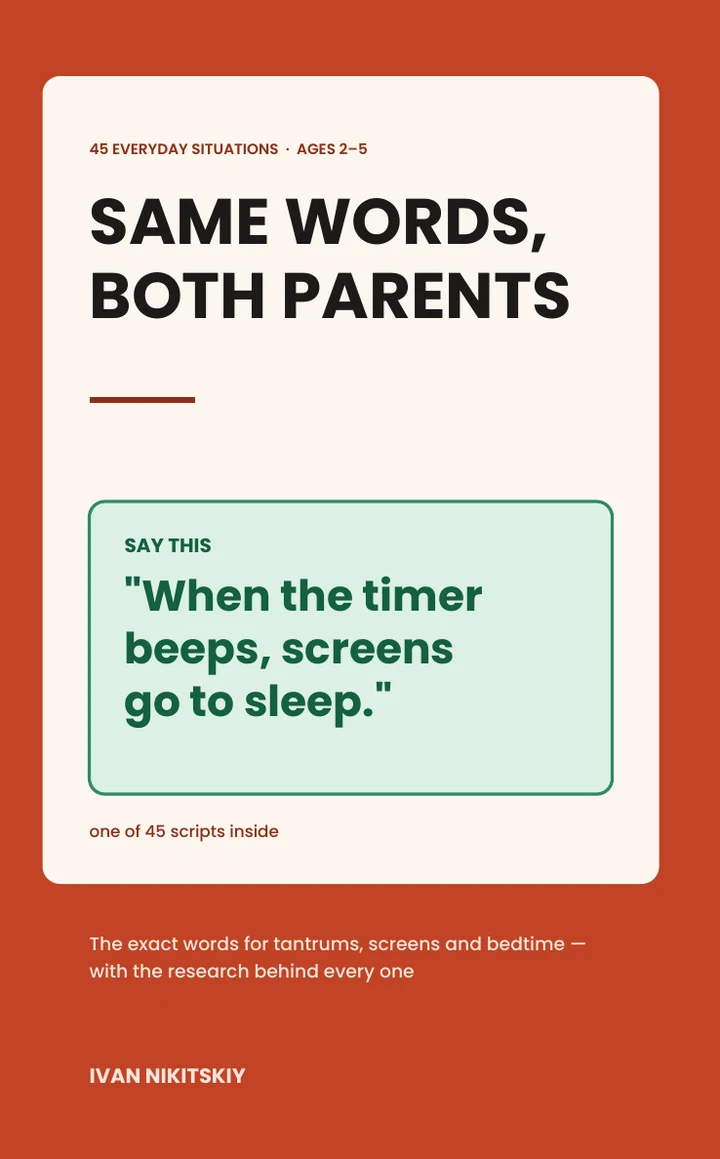
Same Words: Both Parents

45 prepared situations in this family area.