Author’s practical guidance
Hitting you during a meltdown
Source named in the book: Emotion coaching (Gottman) · PCIT
An overwhelmed body discharges through the hands.
Say this now
“I won't let you hit me.”
Said while you are physically preventing it. The sentence describes what you are doing.
“You can be angry. Hitting is not okay. You can stomp or squeeze this pillow.”
Feeling allowed, action refused, replacement offered — all three in one breath.
Do this
- Catch their hands gently but firmly, or step out of reach.
- Protecting yourself is not a failure — it is the clearest boundary lesson available.
- Give the body an exit: stomping, pushing a wall, a cushion to squeeze.
- Keep your face and voice flat. A big reaction is the reward.
- Same script every time. The consistency is the teaching, not the wording.
Avoid this
- "How dare you hit mommy!" — makes it about status, which a three-year-old cannot address.
- Hitting back "so he knows how it feels" — teaches precisely the thing you are trying to stop.
- Long consequences delivered mid-storm.
If it repeats
Praise the alternative loudly the first time it appears: "You were SO mad and you stomped instead." Hitting fades as language arrives, but it fades faster when the replacement gets more attention than the hitting did.
Why the book suggests this
An overwhelmed body discharges through the hands. At two and three the impulse to hit arrives fully formed, and it gets there before any thought about it does. The pause between feeling something and doing it is a skill, and it takes years to build.
This is not disrespect, and reading it as disrespect is what turns an ordinary developmental problem into a fight about authority. Your child is not challenging you. They have no brakes yet, and you are the nearest surface.
Related prepared situations
What happened next?

From this collection
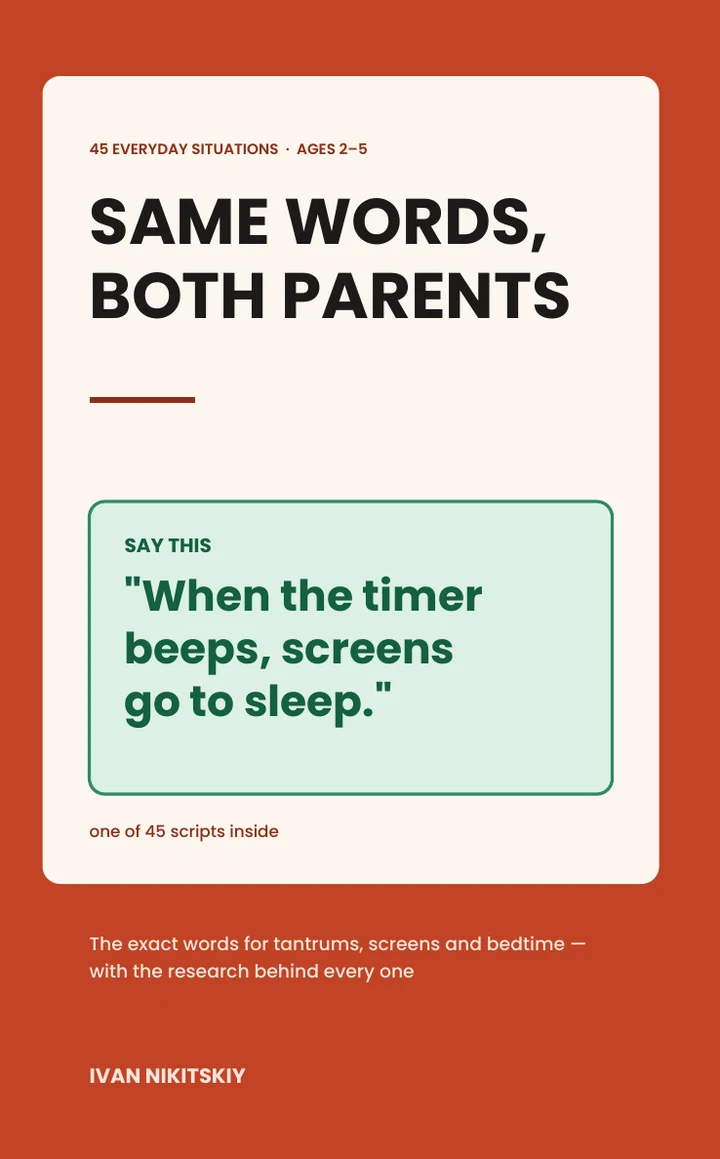
Same Words: Both Parents
45 prepared situations in this family area.