Author’s practical guidance
The power of "yet"
Source named in the book: self-efficacy research (Bandura) · scaffolding (Vygotsky & Bruner)
"I can't ride it." "I can't write my name." Said flatly, as a fact about the world.
Say this now
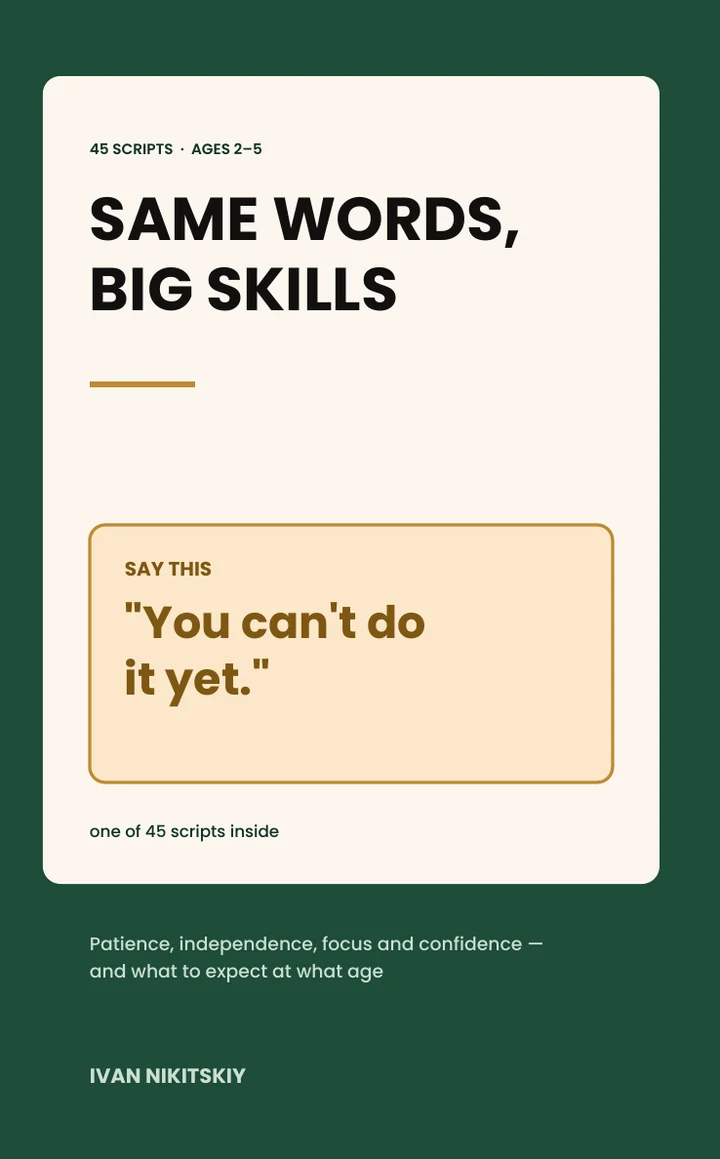
“You can't do it yet.”
Agree with them, then add one word. The agreement is what makes the word land.
“Remember when you couldn't open that door? Now you can.”
Their own history is the proof. Use theirs, not somebody else's.
Do this
- Say the whole sentence back with "yet" on the end, rather than arguing with the first half.
- Keep evidence of the past: old drawings, a photo of them smaller, the shoes that used to be too big.
- Point at what changed this week, not at what is still missing.
- Let the hard thing stay hard for now. "Yet" is not a plan to fix it today.
- Use it on yourself out loud: "I can't get this knot out yet."
Avoid this
- "Yes you can!" — contradicts them, and the argument replaces the practice.
- "You'll get there, don't worry." — a comfort with no timeline in it.
- Attaching "yet" to everything, including things they may never want.
If it repeats
Two-year-olds do not yet register the word. Around three and a half it starts to be repeated back to you, usually as a joke first. Genuine use — a child talking about their own skills as changing — is closer to five, and it needs the evidence in front of them.
Why the book suggests this
"I can't ride it." "I can't write my name." Said flatly, as a fact about the world. For a small child that is exactly what it is: at three, the idea that a skill has a history — that it was absent, then partial, then there — is not yet available. Today is all there is.
One word supplies the missing piece. "Yet" puts the sentence on a timeline, and a timeline is what turns a verdict into a stage. It works because it is true, and it stops working the moment it is used to argue with a child who is upset.

From this collection
Same Words: Big Skills
45 prepared situations in this family area.