
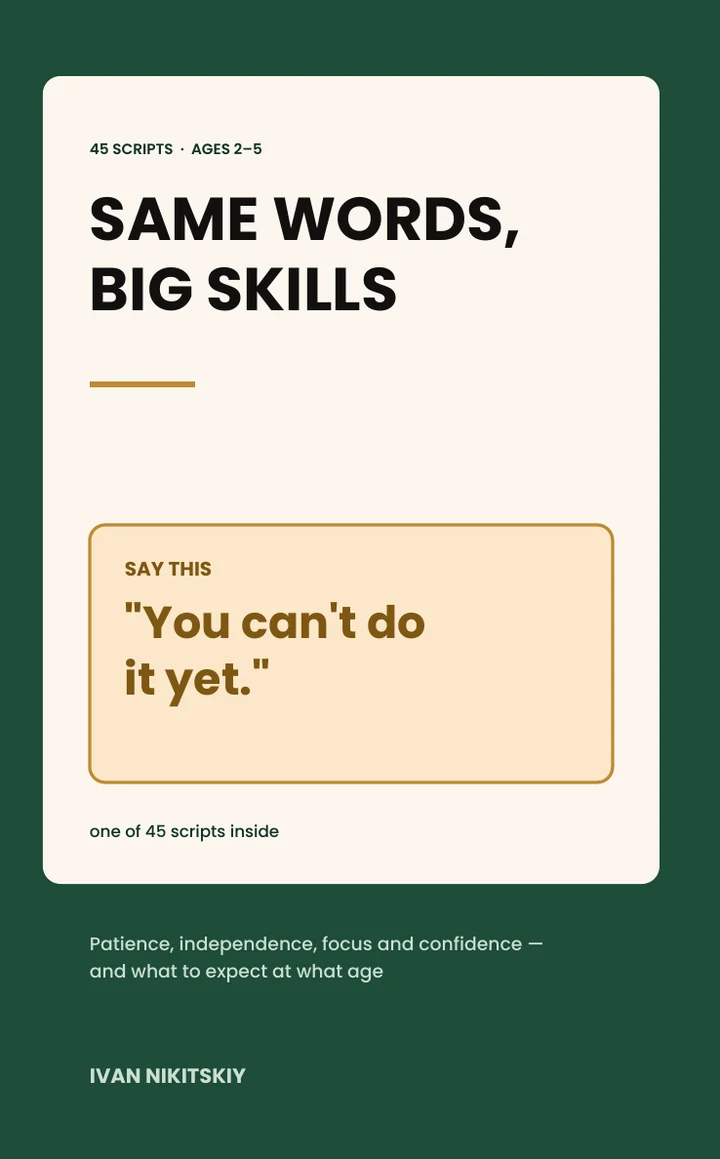
Same Words book
Big Skills
Calm, independence, focus, communication, effort and adapting to change.
View the book on Amazon ↗45 situations covered in this book
From frustration to another tryBig Skills · Calm and recoverySomething does not work the first time, and frustration quickly fills the moment. The unfinished task is still there, but trying again feels far away while the child is caught in how badly the first attempt went.→Fear of making mistakesBig Skills · Calm and recoveryA child faces an activity they could attempt, then pulls back at the possibility of getting it wrong. The mistake has not happened, but worry about it already feels larger than the task itself.→My child is afraid of new or unfamiliar situationsBig Skills · Calm and recoverySomething new or unfamiliar is close enough to approach, but the child hangs back. The activity, place, or person has not become part of ordinary life yet, and hesitation fills the space before contact.→Naming complex emotionsBig Skills · Calm and recoveryThe child's feeling does not fit neatly into happy, sad, or angry. Several emotions seem present at once, while the family looks for language broad enough to hold a complicated inner moment.→Learning to loseBig Skills · Calm and recoveryA game ends with someone else winning, and the child has to meet the loss. The fun of playing changes at the result, when disappointment arrives beside another person's success.→The wrong-color cupBig Skills · Calm and recoveryThe drink is ready, but the cup is the wrong color. A tiny detail becomes the whole problem, and an ordinary part of the day suddenly stops over an object that seemed interchangeable a moment earlier.→"Do it for me!" when they canBig Skills · IndependenceThe child asks an adult to do a task they can already manage. Ability is present, but so is a strong wish to hand the effort, uncertainty, or final step to someone else.→Micro-choices that build autonomyBig Skills · IndependenceA small part of the day offers the child a choice between manageable options. The decision may concern an ordinary detail, yet it gives the child a visible place in what happens next.→Self-care without endless remindersBig Skills · IndependenceA familiar self-care task needs doing, but reminders keep coming from the adult. Dressing, washing, or another routine is within reach, while beginning and finishing it still depend on repeated prompts.→Independent playBig Skills · IndependenceThe child has time and materials for play without an adult directing it. The open stretch can feel inviting or uncertain, especially when nobody else is choosing the game, story, or next move.→Household jobs without bribingBig Skills · IndependenceA household job belongs to family life, but the child expects a reward before taking part. The ordinary work of the home becomes a negotiation about what their effort is worth.→Doing it badly and being allowed toBig Skills · IndependenceThe child takes on a task and does it imperfectly while an adult watches. The result may be slow, uneven, or messy, yet it visibly belongs to the child's own attempt.→Following two- and three-step instructionsBig Skills · Focus and self-controlAn adult gives two or three connected instructions, and the child has to carry them across the room or routine. Each step is simple alone, but together they form a small sequence to remember.→Completing what was startedBig Skills · Focus and self-controlThe exciting beginning is over, but the activity is not finished. The child faces the quieter middle and final steps of something they chose or agreed to start earlier that day.→Stop-and-think in playBig Skills · Focus and self-controlPlay is moving quickly when a moment calls for the child to pause before acting. The game continues around them, while a choice has to fit between an impulse and the next move.→Protecting deep concentrationBig Skills · Focus and self-controlThe child is deeply absorbed in an activity, with attention settled on one small world. Conversation, errands, or other plans wait nearby, but the concentration itself is still unfolding in front of them.→"First this, then that"Big Skills · Focus and self-controlTwo parts of a routine need to happen in a clear order: the required step first and the wanted one afterward. The child is focused on the second while the first remains unfinished.→Starting something that looks too hardBig Skills · Focus and self-controlA new task looks too difficult before the child has begun. Its size, unfamiliarity, or many visible parts fill the moment, making the starting point hard to see or imagine clearly.→Defending what is theirs without hittingBig Skills · With other childrenAnother child reaches for something that belongs to them, and the child wants to defend it without hitting. Ownership, urgency, and another person's body meet around the same object during play.→Joining a game already in progressBig Skills · With other childrenA game is already underway when the child wants to join. The other children have roles, rules, and momentum, while the newcomer stands just outside what is happening between them.→Letting them solve the small stuffBig Skills · With other childrenA small disagreement appears between children, and nearby adults notice it. The problem belongs to the children, but the adults are close enough to feel the immediate pull to enter.→Being glad about somebody else's winBig Skills · With other childrenSomeone else wins, receives attention, or succeeds while the child watches. Another person's happy moment sits beside the child's own disappointment, envy, or strong wish to have won instead today.→Personal space, theirs and other people'sBig Skills · With other childrenChildren move close to one another during play, and personal space becomes part of the interaction. One body may welcome the closeness while another needs more room to feel comfortable there.→Noticing that somebody else is sadBig Skills · With other childrenAnother person looks or sounds sad, and the child begins to notice. The feeling belongs to someone else, yet it enters the shared room through a face, posture, or changed voice.→Praise for effort, not talentBig Skills · Effort and mistakesA child works hard at something and an adult wants to recognize what happened. The effort may be visible in repeated attempts, sustained attention, or staying with a task that was difficult.→The power of "yet"Big Skills · Effort and mistakesThe child cannot do something now, and the unfinished ability feels final. A small word about time sits between today's difficulty and the possibility that the skill may not always feel this way.→Handling feedback on mistakesBig Skills · Effort and mistakesSomeone points out a mistake in the child's work or action. Information about what went wrong arrives close to pride, effort, and the wish to have done the whole thing well.→Keeping a promise they madeBig Skills · Effort and mistakesThe child made a promise earlier, and the moment to keep it has arrived. What sounded possible before now meets the actual effort, delay, or choice involved in following through.→Being watched: showing and performingBig Skills · Effort and mistakesThe child can do the activity alone, but being watched changes the moment. Attention from an audience turns ordinary showing into a performance, with eyes waiting for what happens next.→Saying "no" respectfullyBig Skills · Talking and being heardThe child wants to refuse something while speaking to another person. A real no is present, along with the challenge of expressing it within an ongoing relationship or shared activity.→Asking for help instead of screamingBig Skills · Talking and being heardA task or problem becomes too much, and the child's distress comes out as screaming. Help may be nearby, but the request has not yet taken a form other people can easily understand.→Natural gratitude without forced mannersBig Skills · Talking and being heardSomething kind or helpful happens, and adults are waiting for a polite response. The child's actual feeling and the expected social words do not necessarily arrive at the same moment.→Handling tall tales and early "lying"Big Skills · Talking and being heardThe child tells a story that stretches far beyond what happened. Imagination, wish, memory, and fact appear together, leaving the adults unsure how to understand the confident account they are hearing.→Answering endless questions curiosity-firstBig Skills · Talking and being heardQuestions keep arriving, one opening directly into the next. The child follows curiosity across the conversation, while the adult tries to stay with a trail that seems to have no endpoint.→Sudden change of plansBig Skills · Change and the unfamiliarA plan changes suddenly after the child has already pictured what would happen. The expected outing or activity disappears, and a different version of the day takes its place without warning.→Loss or damage of a favorite objectBig Skills · Change and the unfamiliarA favorite object is lost or damaged, and the child faces a familiar thing that is gone or changed. Its everyday place in life becomes clearest at the moment it cannot be used.→Navigating boredomBig Skills · Change and the unfamiliarNothing available feels interesting, and the child announces or shows their boredom. Time opens without a ready activity, leaving an uncomfortable gap between one engaging thing and whatever comes next.→Safe risk-takingBig Skills · Change and the unfamiliarThe child wants to climb, jump, explore, or try something with a real element of risk. Excitement and uncertainty share the moment while the limits of safety are still visible.→Carrying something breakableBig Skills · Change and the unfamiliarA breakable object is placed in the child's hands. Carrying it turns a short walk into an act of concentration, with the weight and fragility of the object present in every step.→Bedtime reflection: three good thingsBig Skills · In calm momentsAt bedtime, the family looks back over the day for three good things. The room is quiet enough for small memories to return, including moments that might otherwise pass without notice.→Everyday self-control micro-gamesBig Skills · In calm momentsA calm moment becomes a place for tiny games involving waiting, stopping, remembering, or taking turns. The skills appear inside ordinary play, away from the pressure of an immediate conflict.→Role-playing hard situations with toysBig Skills · In calm momentsToys take the roles in a difficult situation the child knows or may soon meet. Through pretend voices and small figures, the hard moment can unfold at a safe distance.→Family rules and visual chartsBig Skills · In calm momentsThe family has rules that need to be understood across ordinary days. A visual chart gives those shared expectations a visible place, turning spoken reminders into something everyone can look at.→Weekly progress reflectionBig Skills · In calm momentsThe family pauses at the end of a week to notice what has changed. Progress may be small or uneven, but the review creates a moment to see movement across several days.→Listening to body signalsBig Skills · In calm momentsThe child notices a signal from their own body, such as hunger, tiredness, tension, or the need for the bathroom. An internal feeling is becoming part of their conscious attention.→