Author’s practical guidance

Praise for effort, not talent

Source named in the book: praise research (Henderlong & Lepper) · self-determination theory (Deci & Ryan)

The tower stands, the shoes are on, the drawing is finished.

Say this now

Option 1
“You kept going after it fell twice.”

Say what they actually did. That is the sentence they can act on tomorrow.

Option 2
“You made the roof flat so it would hold.”

Name the decision, not the result. Decisions are repeatable; results are luck as often as not.

Do this

  • Describe rather than evaluate. A description is praise; children hear it as approval without the verdict.
  • Praise the specific move: the choice, the persistence, the fix they found.
  • Say it quietly and close, rather than across the room.
  • Skip praise entirely for ordinary things. Not everything needs a comment.
  • Watch your own defaults for a day. Most of us have two or three phrases we use automatically.

Avoid this

  • "Good boy!" — praises who they are for something they did.
  • "You're so clever." — the next hard task now threatens the title.
  • Praising everything at the same volume — a child who hears amazing twelve times a day stops hearing it.
If it repeats

At two, praise is heard mainly as your pleasure and the content barely registers. From three the wording starts to matter, and by four or five children can tell you what they did well — but only if somebody has been describing it to them.

Why the book suggests this

The tower stands, the shoes are on, the drawing is finished. What you say in that second is doing more work than anything you say when things go wrong — and most adults reach for the same four words without thinking: good boy, clever girl, well done, amazing.

The difference is small on the surface and large underneath. Praise aimed at the person hands the child a label to protect. Praise aimed at what they did hands them a method to repeat. Both feel warm. Only one of them is usable next time.

Related prepared situations

What happened next?

From this collection

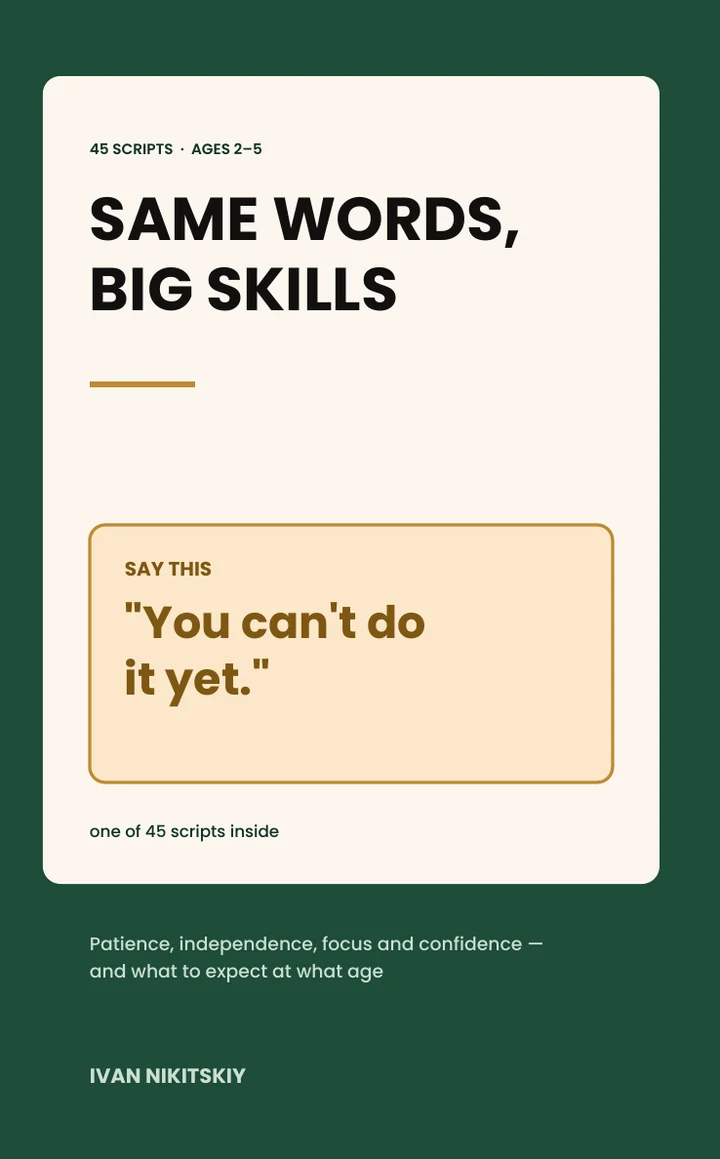
Same Words: Big Skills

45 prepared situations in this family area.