Author’s practical guidance

The goodbye at the door

Source named in the book: attachment and separation protest (Bowlby)

Protest at separation is the attachment system doing its job.

Say this now

Option 1
“Two hugs, then I go. I'll be back after snack.”

A fixed goodbye and a marker they can see coming. Snack is more useful to them than three o'clock.

Option 2
“You're allowed to be sad. I still have to go, and I still come back.”

Holds both. Nothing here needs fixing — it needs to become familiar.

Do this

  • Use the same short goodbye every day, in the same words.
  • Say when you return in events, not in clock time.
  • Leave once you have said you are leaving, even when it is hard to.
  • Hand over to the same adult where the setting allows it.
  • Ask staff how long the crying lasted — usually it is a few minutes.

Avoid this

  • Leaving while they are distracted — buys a quiet exit and pays for it with a week of vigilance.
  • Coming back in for one more hug — restarts the goodbye rather than finishing it.
  • "Big kids don't cry at drop-off." — adds shame to a feeling that was already going to pass.
If it repeats

If it stays intense past the first weeks, look at the handover rather than the child. A named adult who takes them into an activity that is already running settles most drop-offs that a longer goodbye does not.

Why the book suggests this

Protest at separation is the attachment system doing its job. Bowlby's point was that a young child keeps track of where their person is and objects when the distance grows — not because something has gone wrong, but because staying close is how small children have always stayed safe.

What settles it is not a better goodbye. It is repetition: leaving, returning, leaving, returning, until the pattern is known. Which is why the slipping-out version costs so much. A child who cannot predict the leaving starts watching for it all morning.

From this collection

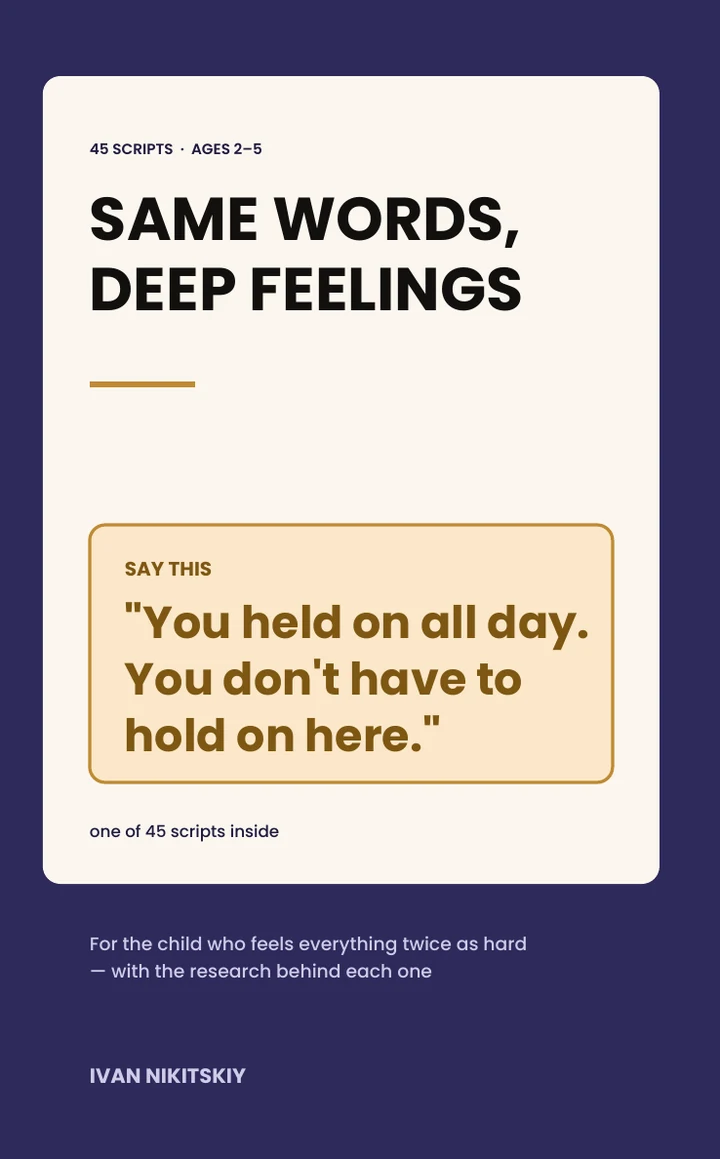
Same Words: Deep Feelings

45 prepared situations in this family area.