
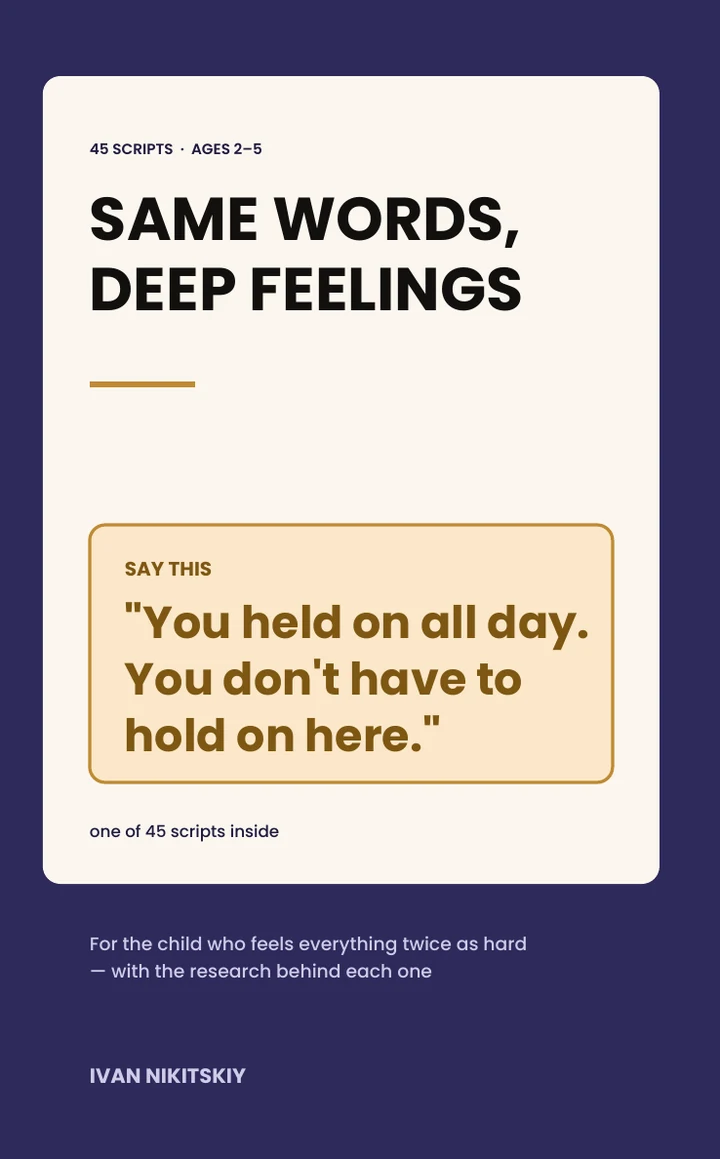
Same Words book
Deep Feelings
Overwhelm, anticipation, intense reactions, empathy and a child’s inner world.
View the book on Amazon ↗45 situations covered in this book
The seam in the sockDeep Feelings · When the world is too muchGetting dressed stops at one small seam inside a sock. To everyone else it may be an ordinary piece of clothing, but for the child wearing it, the feeling is impossible to ignore and the morning cannot move on.→The room got too loudDeep Feelings · When the world is too muchConversation, play, and everyday sounds build until the room feels too loud for one child. Other people may still be comfortable, while the child is suddenly overwhelmed in the middle of an otherwise familiar place.→My child gets upset when foods touchDeep Feelings · When the world is too muchTwo foods touch on the plate, and the child can no longer treat either one as expected. A small point of contact changes the whole meal in a way other people may not understand.→The light is too brightDeep Feelings · When the world is too muchThe light in an ordinary room feels too bright for the child. Everyone else may continue normally, while the glare becomes the main thing the child can notice or talk about.→Water on the headDeep Feelings · When the world is too muchWater reaches the child's head during bathing or swimming, and the moment changes immediately. A familiar activity becomes centered on the feeling of water where the child does not want it.→It smells wrong in hereDeep Feelings · When the world is too muchThe child enters a place and says the smell is wrong. An odor that others barely notice or accept becomes impossible to overlook, changing how the whole room feels to them.→Fine all day, wrecked at the doorDeep Feelings · After they held it inA child appears to manage the whole day, then falls apart at the doorway. The sharp contrast can leave the adult wondering how everything changed between the last part of the day and arriving home.→Getting out the doorDeep Feelings · After they held it inThe family needs to leave, but reaching the door becomes an extended struggle. Clothes, belongings, movement, and anticipation gather around the threshold while time continues outside the house.→Empty after a good playdateDeep Feelings · After they held it inA playdate went well, yet afterward the child seems completely empty. The enjoyable visit is over, and the return home brings a sharp drop in energy, conversation, or emotional steadiness.→Too happy, then in piecesDeep Feelings · After they held it inExcitement rises very high during a happy event, then the child falls apart afterward. Joy and distress appear close together, turning a wonderful experience into an unexpectedly difficult ending.→It takes them longer to come backDeep Feelings · After they held it inAfter becoming overwhelmed or upset, the child takes longer than everyone expects to feel settled again. The event may be finished, but their body and attention have not returned with it.→Stuck at the edge of itDeep Feelings · Before it even startsThe child reaches the edge of an activity, doorway, or group and cannot move into it. Participation is close and visible, yet beginning feels impossible from where they stand.→Dreading it for three daysDeep Feelings · Before it even startsAn event is still three days away, but the child is already dreading it. The future appointment occupies the present, returning to conversations and thoughts long before anything has begun.→The goodbye at the doorDeep Feelings · Before it even startsAt the doorway, a goodbye has to happen and the child does not want the separation. The next place is waiting, while the person leaving still feels central to the moment.→The order changedDeep Feelings · Before it even startsA familiar sequence happens in a different order, and the child notices immediately. The same parts are present, but their changed arrangement makes the routine feel wrong or unfinished.→Nothing to say to grandmaDeep Feelings · Before it even startsGrandma is present and ready to connect, but the child has nothing to say. The family relationship sits inside a quiet visit where expected conversation does not arrive.→Cannot pick the cupDeep Feelings · Before it even startsSeveral cups are available, but the child cannot choose one. A small decision expands until every option feels difficult, leaving the routine paused around an ordinary object.→Hiding under the table over spilled milkDeep Feelings · Bigger than the eventMilk spills, and the child hides under the table. The size of the response overtakes the small accident, turning a wipeable mess into a much larger family moment.→"You hate me!"Deep Feelings · Bigger than the eventThe child believes the adult hates them during a difficult interaction. A limit, expression, or tense exchange becomes a statement about the whole relationship in the child's immediate experience.→Still sorry an hour laterDeep Feelings · Bigger than the eventAn hour after something went wrong, the child is still apologizing or carrying the regret. Everyone else may have moved on, while the earlier moment remains active for them.→Tearing up the drawingDeep Feelings · Bigger than the eventThe child tears up their own drawing after something about it feels wrong. Work that took time disappears in seconds, with disappointment directed at the page they created.→Twenty minutes over a scratchDeep Feelings · Bigger than the eventA small scratch leads to twenty minutes of tears and distress. The mark may be slight, but the child's experience of the event fills a long stretch of family time.→A slight cold, a whole day lostDeep Feelings · Bigger than the eventA slight cold changes the shape of the entire day. Ordinary demands, sounds, and transitions feel harder while the child moves through familiar routines in an uncomfortable body.→They caught your bad moodDeep Feelings · When they feel what others feelThe child notices the adult's bad mood and begins carrying the same emotional tone. One person's difficult day becomes present in another face, voice, or way of moving through the room.→You used a slightly different voiceDeep Feelings · When they feel what others feelThe adult uses a voice that is only slightly different, and the child reacts immediately. A small shift in tone carries more meaning for them than the actual words being spoken.→Crying about the dead birdDeep Feelings · When they feel what others feelThe child finds or sees a dead bird and begins to cry. A small animal outside becomes their close encounter with death, sadness, and something that cannot start moving again.→Grandpa is ill and they are lostDeep Feelings · When they feel what others feelGrandpa is ill, and the child is trying to understand what that means. Adult concern surrounds someone they love, while the future and even the present may feel uncertain.→The sad part of the storyDeep Feelings · When they feel what others feelA story reaches its sad part, and the child's feelings move beyond the page or screen. The characters' loss or fear becomes emotionally present in the room where the story is being shared.→"You can't play"Deep Feelings · With other childrenOther children tell the child they cannot join their play. A social boundary appears in a few direct words, leaving one child outside a game that continues nearby.→"Why is that lady so fat?"Deep Feelings · With other childrenThe child comments loudly on a stranger's body in public. Their question is direct and audible, placing curiosity, another person's privacy, and the adult's embarrassment in one moment.→The face they think you madeDeep Feelings · With other childrenThe child believes an adult made a particular face at them. A brief expression becomes the center of the interaction, even when the adult remembers or intended something different.→Losing the gameDeep Feelings · With other childrenA game ends in a loss, and the result feels much larger than play. The child faces another person's win while their own hopes for the ending disappear.→Everyone is singing at themDeep Feelings · With other childrenA group begins singing directly to the child, placing every face and voice on them. What others intend as celebration can feel like intense attention with nowhere to hide.→They did not hear you at allDeep Feelings · Their own worldThe child was so absorbed in their own activity that they did not hear the adult at all. Words were spoken nearby, but never seemed to enter the world holding their attention.→The friend who is not thereDeep Feelings · Their own worldThe child talks, plays, or plans around a friend who is not physically there. The unseen companion has a place in daily life that feels real within the child's private world.→A pocket full of nothingDeep Feelings · Their own worldThe child's pocket is full of tiny objects that look like nothing important to an adult. Each scrap, stone, or fragment belongs to a collection with meaning known mainly to them.→It has to be done the same wayDeep Feelings · Their own worldA routine must happen in exactly the same way, and even a small change feels wrong. Order, objects, or wording become fixed points in an otherwise ordinary part of the day.→They do not want the book to endDeep Feelings · Their own worldThe child does not want the book to reach its final page. The story is still present and shared, while its ending means leaving a world they are not ready to close.→The moth in the bathroomDeep Feelings · Their own worldA moth appears in the bathroom and captures the child's full attention. The small visitor may feel fascinating, frightening, or both, transforming a familiar room into unfamiliar territory.→You are the one who is doneDeep Feelings · The adults around themThe child is overwhelmed, but the adult has reached their own limit too. Two strained people share the same room, and neither has much steadiness available for the other.→"You're spoiling him"Deep Feelings · The adults around themAnother adult says the parent is spoiling the child. A difficult moment becomes a judgment about the whole relationship, offered from outside while parent and child are still inside it.→Our house is too loud for himDeep Feelings · The adults around themThe family realizes their home feels too loud for one child. Ordinary voices, play, appliances, and movement combine into an environment that one household member experiences differently.→The day comes out at bedtimeDeep Feelings · The adults around themAt bedtime, feelings from the entire day begin to appear. The lights are low and activities are ending, but earlier disappointments, effort, and tension arrive all at once.→It was the sleep, not the sugarDeep Feelings · The adults around themA difficult day follows poor sleep, while sugar receives the blame in family conversation. Tiredness and food become competing explanations around the same behavior, mood, and lost rhythm.→The same trait, later onDeep Feelings · The adults around themA trait that feels difficult now is imagined later in the child's life. Intensity, caution, persistence, or sensitivity looks different when the family pictures it in an older person.→