Author’s practical guidance
The day comes out at bedtime
Source named in the book: sleep needs in early childhood (AAP)
The questions arrive at nine at night for a straightforward reason: it is the first point in the day with nothing else running in it.
Say this now
“That's important. Let's talk about it tomorrow at breakfast.”
Only works if you actually do it. Then it works permanently.
“Tell me the short version now.”
Enough to set it down without opening the whole thing at bedtime.
Do this
- Build the gap in earlier — ten minutes after dinner, doing nothing.
- Keep bedtime answers short and keep your voice low.
- Write it on a list together and deal with it in the morning.
- Hold the same bedtime even in weeks when everything else moves.
- Return to it at breakfast without being asked.
Avoid this
- "We'll talk in the morning." — they will not, and now they hold it alone.
- A long conversation at ten — nothing gets resolved and the night gets shorter.
- "Why didn't you say this earlier?" — there was no earlier with a gap in it.
If it repeats
Preschoolers need roughly ten to thirteen hours of sleep in a day, naps included. If bedtime keeps stretching, move the whole evening earlier rather than trying to shorten the conversation at the end of it.
Why the book suggests this
The questions arrive at nine at night for a straightforward reason: it is the first point in the day with nothing else running in it. Everything that happened has been waiting for a gap, and bedtime is the gap.
There is a second reason to expect it. Sleep pressure is highest exactly then, and a tired child has the least capacity to sort what happened into manageable pieces. So the day comes out at the moment they are worst equipped to handle it — and the answer is earlier, not longer.

From this collection
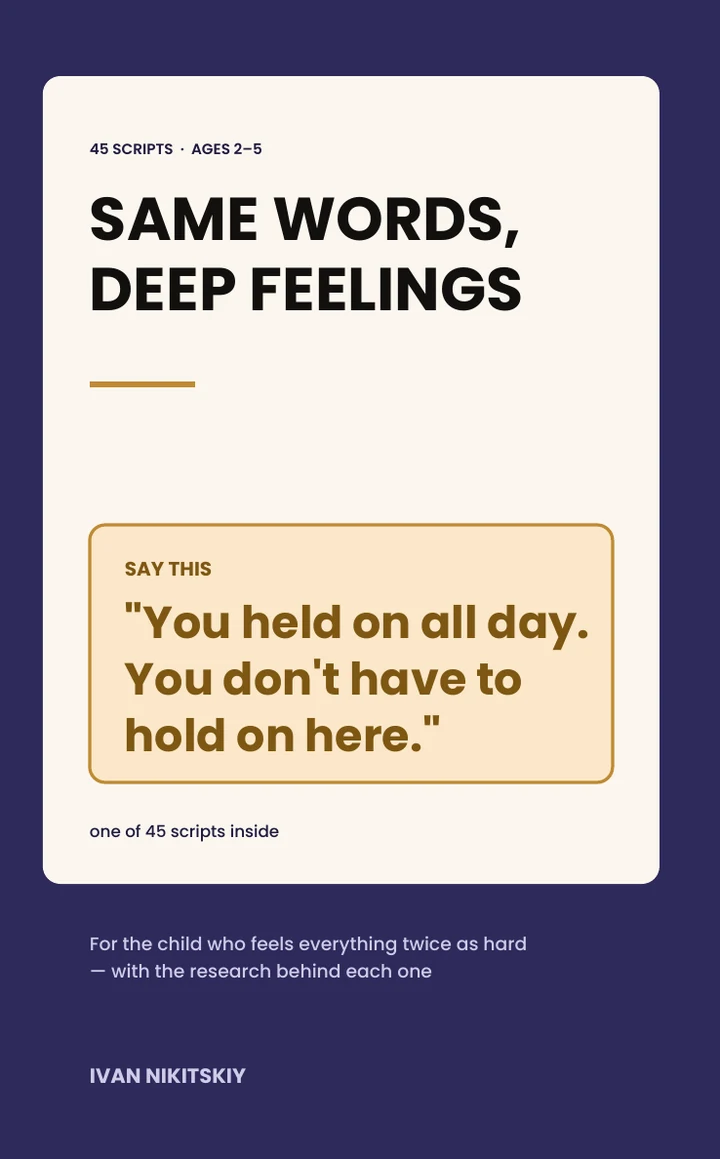
Same Words: Deep Feelings
45 prepared situations in this family area.