Author’s practical guidance
Awake and ready to play
Source named in the book: sleep need and time in bed (Mindell)
An hour awake in the middle of the night, cheerful and chatty, is usually not distress.
Say this now
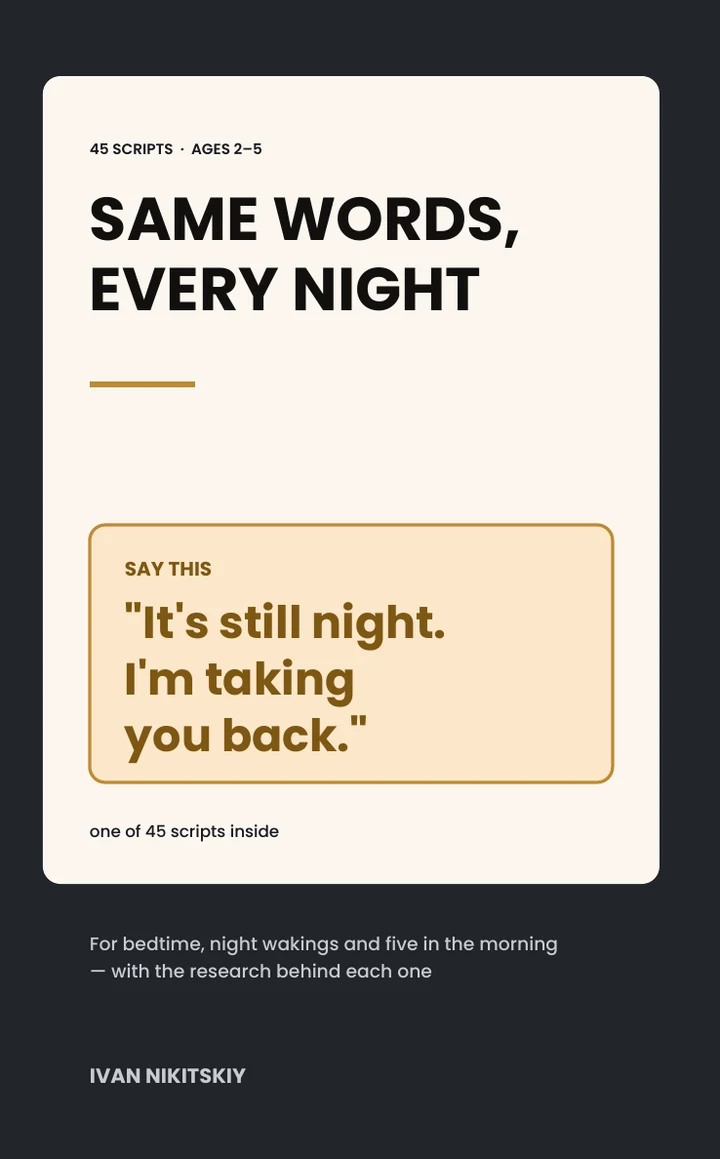
“It's still night. Nothing happens now.”
States what the hour is for without arguing about whether they feel awake.
“Stay in your bed. I'm going back to mine.”
The plainest available rule, and you demonstrate it on the way out.
Do this
- Count the whole twenty-four hours first — nap and night together, across a week.
- Trim time in bed rather than sleep: a later bedtime or a shorter nap, one at a time.
- Keep the awake hour dark and boring — no screen, no snack, no conversation.
- Hold the morning wake-up steady even after a bad middle.
- Give any change two weeks before you judge it.
Avoid this
- Turning on the light and starting the day — you have moved the morning, not ended the waking.
- Letting them play until they are tired again — the awake hour becomes a scheduled part of the night.
- Sleeping in to make up for it — that adds sleep to the day, which is the cause.
If it repeats
If the awake hour keeps its place after two weeks, look at the nap. At this age it is the easiest hour to move, and taking thirty minutes off it often closes the gap in the night without touching bedtime at all.
Why the book suggests this
An hour awake in the middle of the night, cheerful and chatty, is usually not distress. It is arithmetic. Sleep need varies between children, and time in bed beyond what this one needs comes out somewhere — often as a wide-awake stretch at two in the morning.
What keeps it in place is what happens during it. Light, a snack, company, anything to do: Mindell's work is blunt about this. The hour stops being a leftover and becomes an appointment the body starts keeping.
Related prepared situations
What happened next?

From this collection
Same Words: Every Night
45 prepared situations in this family area.