
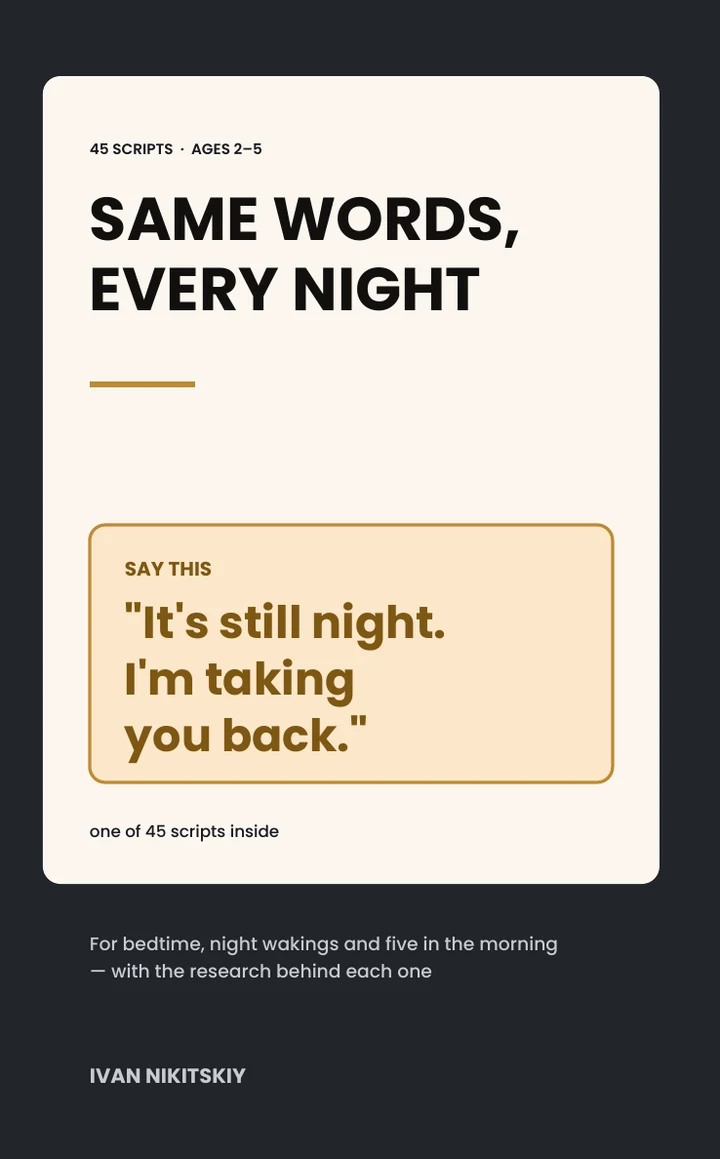
Same Words book
Every Night
Bedtime, night waking, fear of the dark, early mornings and adult exhaustion.
View the book on Amazon ↗45 situations covered in this book
The second wind at seven o'clockEvery Night · The hour beforeEvening arrives, but the child suddenly seems ready for a new day. At seven o'clock, the expected slowing down is replaced by fresh energy, lively movement, and a bedtime that no longer looks close.→"I'm not tired" while rubbing their eyesEvery Night · The hour beforeThe child's eyes are being rubbed, yet bedtime is met with a firm claim of not being tired. What the adults see and what the child insists on seem to belong to two different evenings.→The bedtime that keeps sliding laterEvery Night · The hour beforeBedtime moves later across days or weeks, a little at a time. The old hour remains in memory, while the actual end of the evening keeps arriving beyond it.→The evening that ran lateEvery Night · The hour beforeThe evening runs late, carrying dinner, travel, visitors, or unfinished plans beyond the usual time. Bedtime still has to happen after the family's normal rhythm has already slipped.→The screen goes off and the evening breaksEvery Night · The hour beforeThe screen turns off, but the evening does not simply continue. The sudden change disrupts what comes next, pushing aside the familiar sequence that was supposed to lead toward bedtime.→Winding down a child who winds upEvery Night · The hour beforeAs bedtime approaches, the child becomes more active instead of less. Movement, noise, and new ideas fill the hour when the household expected energy to soften.→Falling asleep only if you are in the roomEvery Night · At the doorThe child falls asleep only while an adult remains in the room. Bedtime depends on that nearby presence, and leaving becomes difficult before sleep has fully arrived.→My child keeps getting up after bedtimeEvery Night · At the doorFor several nights, the child gets out of bed again after being settled. Each return opens the bedtime boundary once more, repeating across nights three through ten.→The pacifier or the thumb at nightEvery Night · At the doorAt night, the child relies on a pacifier or thumb as part of falling asleep. The familiar habit sits at the center of bedtime and may continue after the room is dark.→The lovey, the light, the open doorEvery Night · At the doorA lovey, a particular light, and an open door all matter at bedtime. Small details of the room become the conditions that make the child feel ready to remain there.→Putting two children to bed aloneEvery Night · At the doorOne adult is putting two children to bed without another pair of hands. Different routines, rooms, and needs overlap during the same narrow part of the evening.→Out of your bed into their ownEvery Night · At the doorThe child has been sleeping in the adult's bed and is moving toward their own. Two sleeping places carry different feelings of closeness, familiarity, and separation at night.→My child comes to my bedside in the nightEvery Night · The middle of the nightAt two in the morning, the child appears beside the adult's bed. The house is dark and sleep has been interrupted by a small person waiting at the bedside.→Milk at three in the morningEvery Night · The middle of the nightThe child wakes at three in the morning asking for milk. A daytime drink has become part of the night, linking hunger, habit, comfort, and interrupted sleep.→Awake and ready to playEvery Night · The middle of the nightThe child wakes during the night and seems ready to play. Their energy belongs to daytime, while the dark room and sleeping household remain firmly in nighttime.→Awake at the end of every cycleEvery Night · The middle of the nightSleep repeatedly breaks as one cycle ends and another should begin. The child wakes again and again, turning the night into many short stretches rather than one continuous rest.→A wet bed and no shame in itEvery Night · The middle of the nightThe child wakes to a wet bed. Sheets, clothes, and sleep need attention, but the accident is also a vulnerable moment in the middle of the night.→The weeks when it all comes undoneEvery Night · The middle of the nightFor several weeks, the sleep pattern that once worked comes apart. Bedtime, waking, naps, or early mornings all feel less predictable during the same unsettled period.→My child is scared of a monster under the bedEvery Night · When the dark is frighteningAt bedtime, the child is certain a monster is under the bed. The familiar bedroom changes after dark, and the unseen space beneath them feels occupied.→Crying out of a dreamEvery Night · When the dark is frighteningThe child cries out after a dream and wakes frightened. Images from sleep still feel close, even as the real bedroom and familiar adults come back into view.→Screaming but not awakeEvery Night · When the dark is frighteningThe child screams during the night but does not seem fully awake. Their body is active and distressed while ordinary recognition or conversation is not clearly present.→Shadows, wind and the house at nightEvery Night · When the dark is frighteningAfter dark, shadows, wind, and ordinary house sounds feel unfamiliar. The same rooms known in daylight take on new shapes and noises once the child is in bed.→"What if something happens to you"Every Night · When the dark is frighteningAt night, the child asks what would happen if something happened to the adult. Bedtime brings a frightening possibility into the quiet space before separation and sleep.→Night lights, sounds and what actually helpsEvery Night · When the dark is frighteningThe family is considering night lights, background sounds, and other features of the bedroom. Darkness and noise feel different to each child, making the sleep setting part of the nightly question.→Five in the morning and the clock that decidesEvery Night · Too earlyThe child wakes at five, and a clock is meant to mark whether morning has begun. Their body is awake while the household's chosen start time remains ahead.→How much sleep is actually enoughEvery Night · Too earlyThe family is trying to understand whether the child sleeps enough. Bedtime, waking, naps, mood, and daily energy all enter a question without one obvious answer.→Hungry before the sunEvery Night · Too earlyThe child wakes hungry before sunrise. Breakfast belongs to morning, but hunger is already present while the house and sky still seem to be asleep.→Heavy and slow every morningEvery Night · Too earlyEvery morning, the child seems heavy and slow as the day begins. Getting up, dressing, and joining the household take place through visible tiredness.→The tablet as the first thing they seeEvery Night · Too earlyA tablet is the first thing the child sees or asks for after waking. Screen time enters before breakfast, dressing, or the household's other morning contact.→When the second nap goesEvery Night · The daytime sleepThe child's second daytime nap begins to disappear. A familiar sleeping period becomes uncertain, leaving the afternoon between the old schedule and a longer stretch awake.→The nap is over but the day is notEvery Night · The daytime sleepThe child wakes from a nap, but many hours remain before bedtime. Daytime sleep has ended without restoring an easy rhythm for the rest of the day.→Thirty minutes and tearsEvery Night · The daytime sleepThe nap lasts only thirty minutes and ends in tears. A short sleep leaves the child awake but unhappy, with the afternoon still waiting beyond the bedroom.→The five o'clock nap in the carEvery Night · The daytime sleepAt five o'clock, the child falls asleep in the car. The late nap arrives close to evening, while the family is traveling toward dinner and bedtime.→Sleeps at daycare, not at homeEvery Night · The daytime sleepThe child sleeps during daycare naps but not during naps at home. The same part of the day unfolds differently across two familiar settings.→The night at grandparents'Every Night · When the night is not the usual oneA night at the grandparents' house brings a different room, routine, and nearby adult. Sleep has to happen away from the child's usual home setting.→Hotels, trips and other time zonesEvery Night · When the night is not the usual oneA hotel, trip, or new time zone shifts the familiar markers of night. The family is away from home while bodies, clocks, and routines disagree about bedtime.→The sick nightEvery Night · When the night is not the usual oneIllness turns the night into repeated waking, discomfort, checks, and close contact. Normal sleep expectations recede while both child and adult move through a sick night.→Snoring, open mouth, restless nightsEvery Night · When the night is not the usual oneThe child snores, sleeps with an open mouth, or moves restlessly through the night. Sleep is happening, but its sounds and movement draw adult attention.→One room, two childrenEvery Night · When the night is not the usual oneTwo children share one room at night. Different bedtimes, noises, waking patterns, and needs now occupy the same sleeping space.→New bed, new room, new babyEvery Night · When the night is not the usual oneA new bed, room, or baby changes the child's nighttime setting. Sleep must continue while familiar places and family arrangements are shifting around it.→One of you holds, the other gives inEvery Night · The adults in the darkAt night, one adult keeps holding the boundary while the other gives in. Exhaustion and different responses become visible between two parents in the dark.→"You're spoiling him" at the kitchen tableEvery Night · The adults in the darkAt the kitchen table, one adult says another is spoiling the child at night. A sleep disagreement becomes a judgment about closeness, limits, and parenting.→Does letting them cry do harm?Every Night · The adults in the darkThe adults wonder whether leaving the child to cry could cause harm. A nighttime decision carries fear about both the immediate distress and the relationship beyond it.→Nothing left by nineEvery Night · The adults in the darkBy nine at night, the adult feels completely empty while bedtime is still happening. The child's needs continue after the last of the day's patience seems gone.→Weekends, holidays and the same wordsEvery Night · The adults in the darkWeekends and holidays change daytime schedules, but the family still meets bedtime. Familiar nighttime language sits inside days that look different from the usual week.→