Author’s practical guidance

Thirty minutes and tears

Source named in the book: self-settling and sleep cycles (Sadeh)

A nap that ends after half an hour has ended at the join between two sleep cycles.

Say this now

Option 1
"It's still rest time." — same words as at night.

The afternoon deserves the same script. Different words make it a different situation.

Option 2
“I'll be back when rest time is finished.”

Ends the calling without ending the nap, and keeps your return on your schedule.

Do this

  • Put them down awake for the nap the same way you do at night.
  • Wait five minutes before going in — a good proportion resettle inside that window.
  • Darken the room properly; afternoon light ends more naps than noise does.
  • Keep the same sound running from the start of the nap to the end.
  • Hold the nap start time steady for two weeks before judging anything.

Avoid this

  • Rushing in at the first sound — you have ended a nap that had five more minutes of deciding to do.
  • Moving them once they are asleep — they wake in the wrong room and the nap is over.
  • Giving up and starting the afternoon — the short nap then becomes the new normal length.
If it repeats

If the short nap holds and the afternoon collapses, bring bedtime forward rather than fighting for a longer nap. A thirty-minute sleeper with an early bedtime does better than a child kept up for a nap that never comes.

Why the book suggests this

A nap that ends after half an hour has ended at the join between two sleep cycles. Everyone comes near the surface there. The question is whether the child goes back down or wakes up, and at that point the room decides it.

Sadeh's work on settling applies to the afternoon as much as the night. A child who went to sleep in the car and woke in a dark room, or in your arms and woke in a bed, has to be put back down by somebody. A child who fell asleep where they wake up mostly rolls over.

Related prepared situations

What happened next?

From this collection

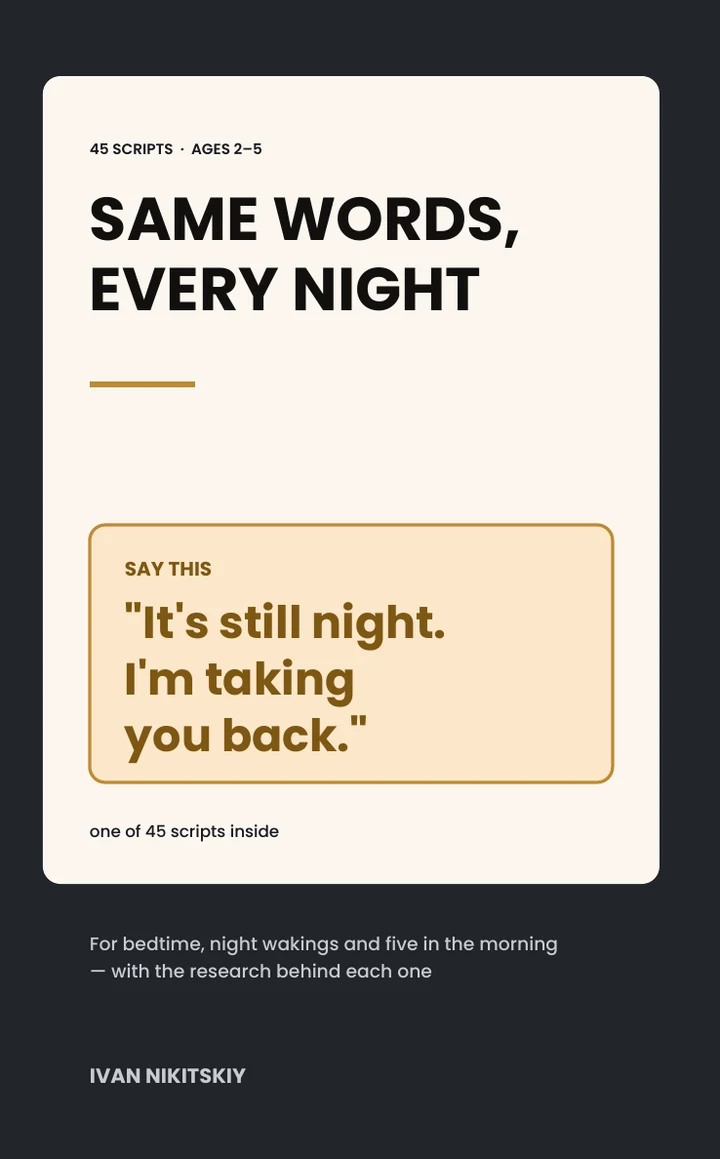
Same Words: Every Night

45 prepared situations in this family area.