Author’s practical guidance
The nap is over but the day is not
Source named in the book: routine and consistency (Mindell)
Naps end somewhere between three and five, and rarely on a clean date.
Say this now
“Quiet time. Books and your bed. I'll come when it's finished.”
Sets the content and the ending, so nothing has to be negotiated in the middle.
“You can play quietly. You can't come out.”
The rule is the room, not the sleeping — and that is a rule a four-year-old can keep.
Do this
- Keep the same time every day, including weekends.
- Set a timer or a light so the ending is not your decision.
- Start at forty minutes and stretch it once it is working.
- Leave a fixed set of quiet things — books, soft toys, nothing with a screen.
- Expect them to sleep some days — if it goes past an hour, wake them.
Avoid this
- Ending rest time because they stopped sleeping — you have removed the only quiet hour in the day.
- "Just lie down and you'll fall asleep." — the promise fails, and the hour becomes a fight about sleeping.
- Letting the hour drift by an hour or two — a rest at four in the afternoon costs you the night.
If it repeats
If they fall asleep in quiet time and then fight bedtime, cap it at thirty minutes and wake them. On the days they need it a short sleep does no harm to the night, but an hour and a half at three in the afternoon will push lights out to nine.
Why the book suggests this
Naps end somewhere between three and five, and rarely on a clean date. What matters is that the hour does not have to end with the sleep. A child who has stopped napping still runs out of tolerance in the afternoon, and so does the adult with them.
Mindell's work is about the sequence rather than the sleep, and that is exactly what survives here. The same short routine at the same time produces a quiet hour whether or not anyone sleeps, and after a few weeks that hour holds by itself.

From this collection
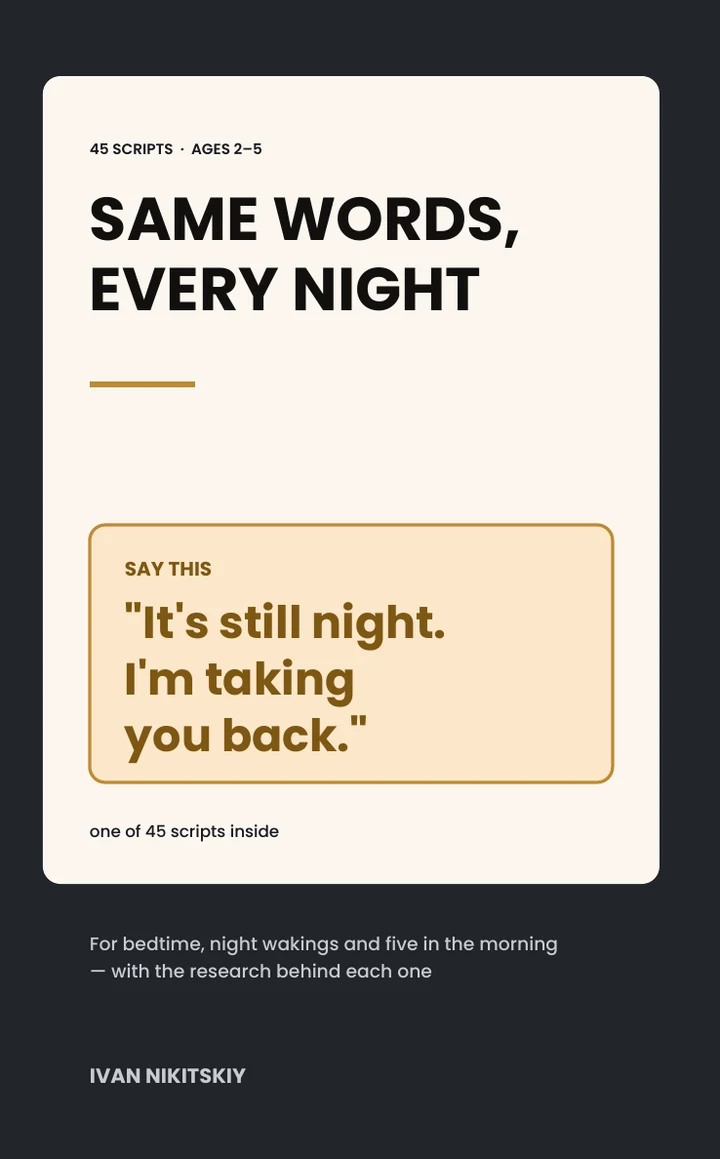
Same Words: Every Night
45 prepared situations in this family area.