Author’s practical guidance

Weekends, holidays and the same words

Source named in the book: the development of inhibitory control (Diamond)

Children this age read context rather than rules.

Say this now

Option 1
“Same bedtime on weekends. Different morning.”

Puts the flexibility where it costs nothing and keeps it away from the end that does.

Option 2
“Tonight is a late one. Tomorrow is the usual.”

A named exception with an end. Unnamed ones are the ones that stay.

Do this

  • Keep bedtime within half an hour across all seven days.
  • Let the wake-up be the flexible end, not lights out.
  • Give the sequence to every adult involved — both houses, grandparents, sitters.
  • Name any exception out loud and name the return in the same sentence.
  • Put the ordinary night back the next day, not the day after that.

Avoid this

  • A late Saturday to make up for a hard week — Sunday and Monday are where you pay for it.
  • Different rules at each parent's house — the child is not being difficult. They are being accurate.
  • "Just tonight" more than once a month — at that frequency it is not an exception, it is the schedule.
If it repeats

If the schedule survives the week and dies every weekend, work on the weekend and leave the weeknights alone. Two nights out of seven is enough to keep a bedtime unsettled indefinitely, and it is usually the easier of the two to fix.

Why the book suggests this

Children this age read context rather than rules. A bedtime that applies on Tuesday and not on Saturday is not one rule with an exception — it is two situations, and they will work out which one they are in faster than you can explain the difference.

Diamond's work on inhibitory control is the reason this matters more at three than at ten. The capacity to hold a rule against a wish is years from finished, so what does the holding is the environment: the same time, the same order, the same sentence.

From this collection

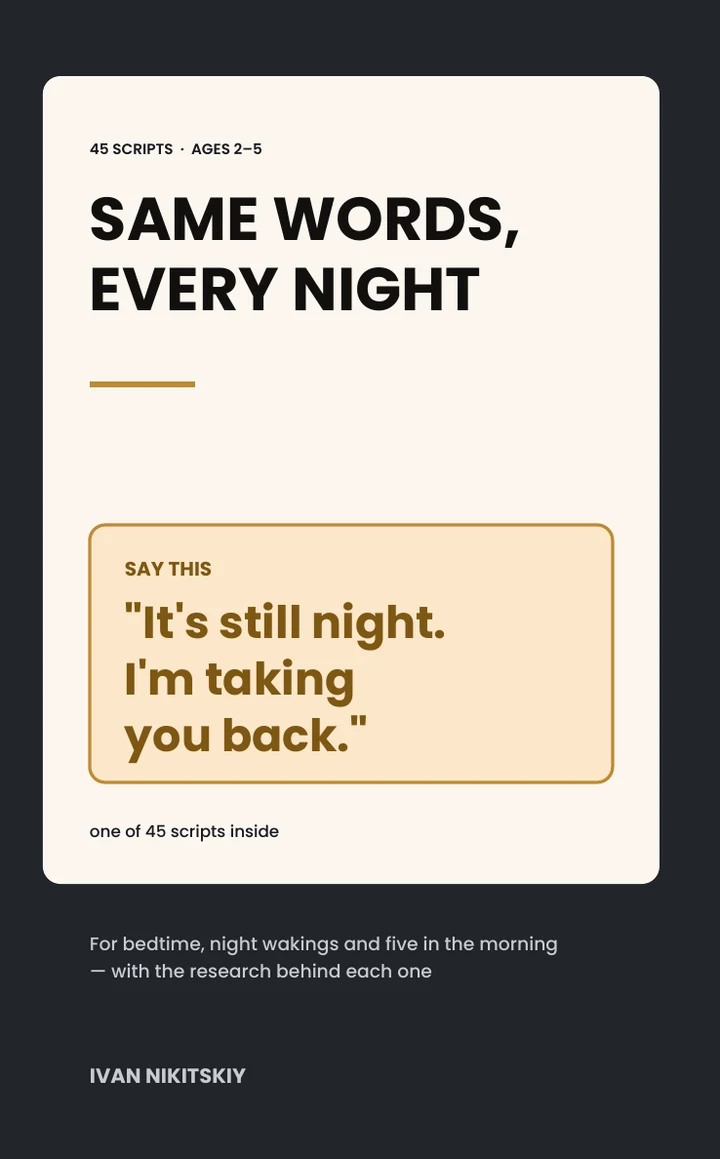
Same Words: Every Night

45 prepared situations in this family area.