Author’s practical guidance
Nothing left by nine
Source named in the book: the two-way link between parent and child sleep (Sadeh)
Broken sleep does not divide evenly.
Say this now
(to each other) "Tonight is yours. Wednesday is mine."
A whole night each beats two broken halves, and it is the single change that helps most.
“I need one morning where I don't get up.”
A specific, small request that can be said yes to. Vague exhaustion cannot be helped with.
Do this
- Take whole nights in turn, not halves of the same night.
- Protect one morning a week for each adult, on the calendar.
- Go to bed before eleven on the nights you are on duty.
- Ask for the specific hour you need, not for help in general.
- Say out loud how bad it is — the other adult is often waiting to be told.
Avoid this
- Splitting every night down the middle — two people half-slept is worse than one person slept.
- Waiting until you are desperate to ask for help — the ask lands worse and the help arrives later.
- Fixing it with caffeine and a later bedtime — you are borrowing from the same account.
TALK TO YOUR DOCTOR IF
- Sleep does not restore you even when you get it.
- You feel low, flat or numb most days for two weeks.
- Anger arrives faster than it used to, most nights.
- You are falling asleep at the wheel or at work.
- Frightening thoughts you cannot switch off.
Why the book suggests this
Broken sleep does not divide evenly. The adult who gets up is running on fragments, and fragmented sleep costs more than short sleep does — patience, judgment and the ability to be pleasant at seven in the morning all go before the tiredness itself is noticeable.
Sadeh's work found this runs both ways: parents' sleep and children's sleep move together, and the adult's state feeds back into the evening. Which means your rest is part of the child's plan and not a reward for finishing it.

From this collection
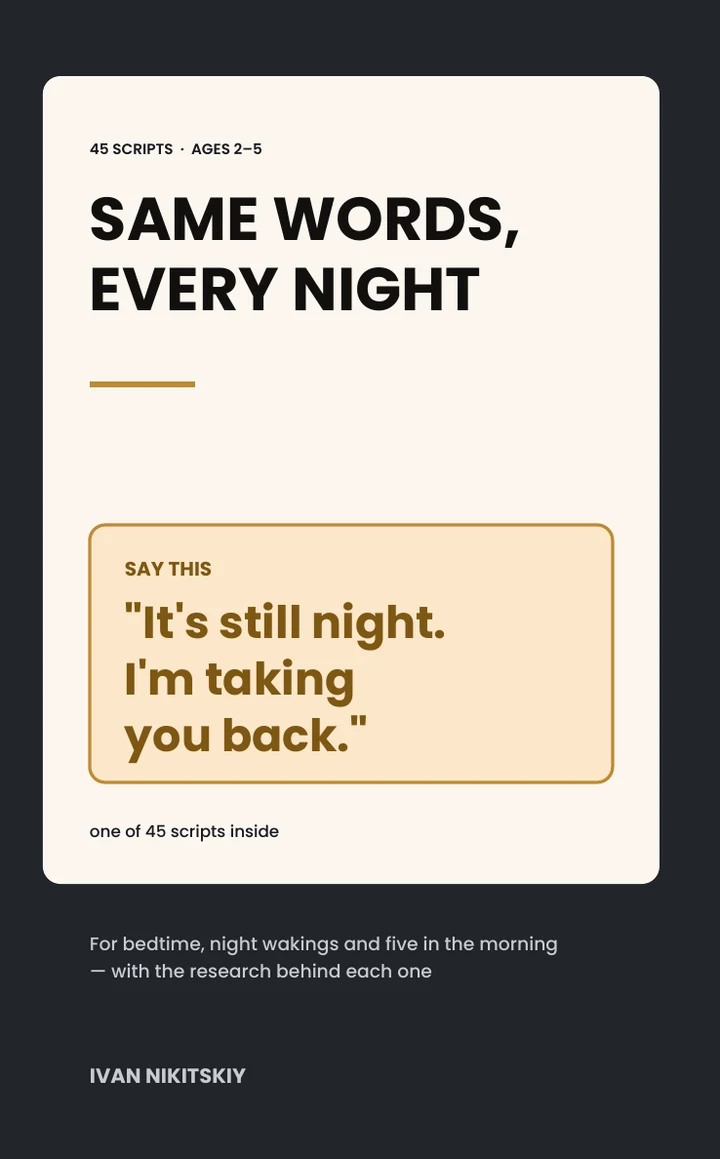
Same Words: Every Night
45 prepared situations in this family area.