Author’s practical guidance
Wants a completely different meal than the rest of the family
Source named in the book: Division of Responsibility (Satter)
A toddler who has just discovered preference will test how far it reaches, and dinner is the most frequent place to test it.
Say this now
“This is what's for dinner tonight.”
Stated once, without an offer hiding behind it.
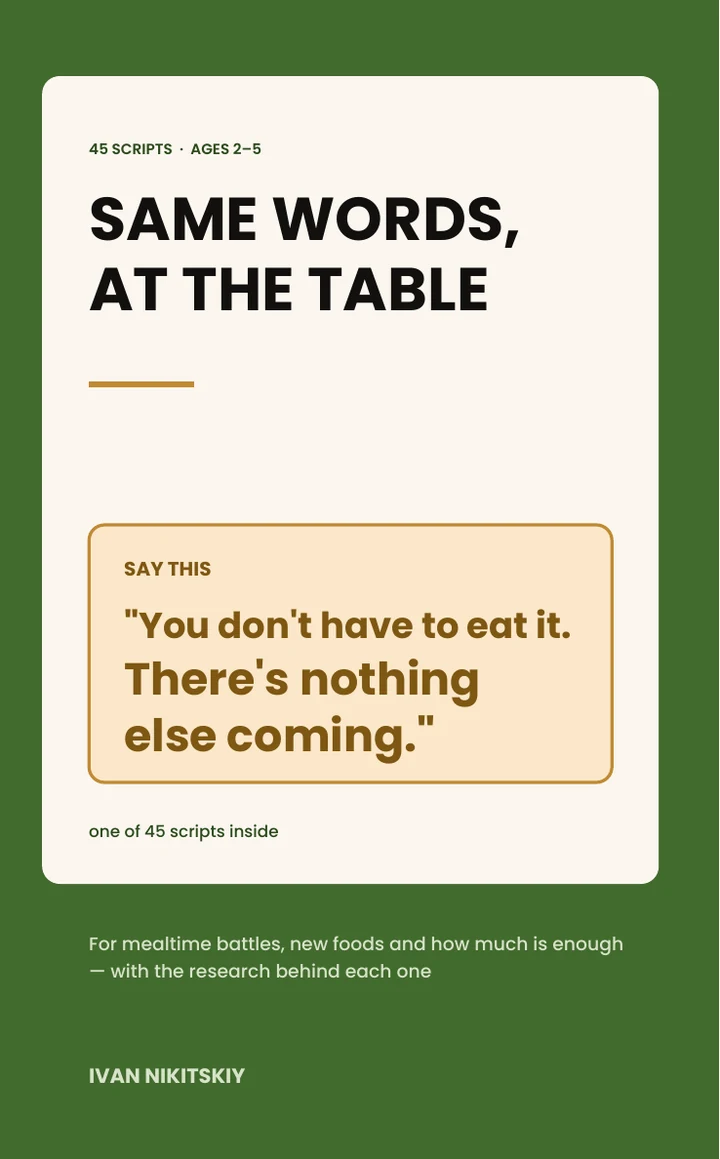
“You don't have to eat it. There's nothing else coming.”
Removes both the fight and the exit.
Do this
- Serve one meal for the whole family, most nights.
- Include one component you already know they eat, on the shared plate, not a separate dish.
- Hold the line the same way every night for at least two weeks.
- Skip the short-order kitchen even when you are tired.
- Let the next meal be the reset — nobody goes without food overnight over one skipped dinner.
Avoid this
- "Fine, I'll make you something else." — teaches that refusal is a menu request.
- "Just try it and I'll make your favorite tomorrow." — turns tonight's dinner into a toll for tomorrow's.
- Arguing about whether the meal is good — a taste argument nobody can win.
If it repeats
If refusing the family meal has become the nightly opener rather than an occasional test, look at what happens right after it — a snack, extra attention, a later bedtime story as consolation. Whatever reliably follows the refusal is very likely what is keeping it going.
Why the book suggests this
A toddler who has just discovered preference will test how far it reaches, and dinner is the most frequent place to test it. Asking for something else is not a judgment on the meal — it is a bid to see who is actually in charge of the kitchen tonight.
Making a second meal answers that bid with a yes, every time, and the child learns the fastest route to a different plate is refusing the first one. The lesson lands even though nobody meant to teach it.

From this collection
Same Words: At the Table
45 prepared situations in this family area.