
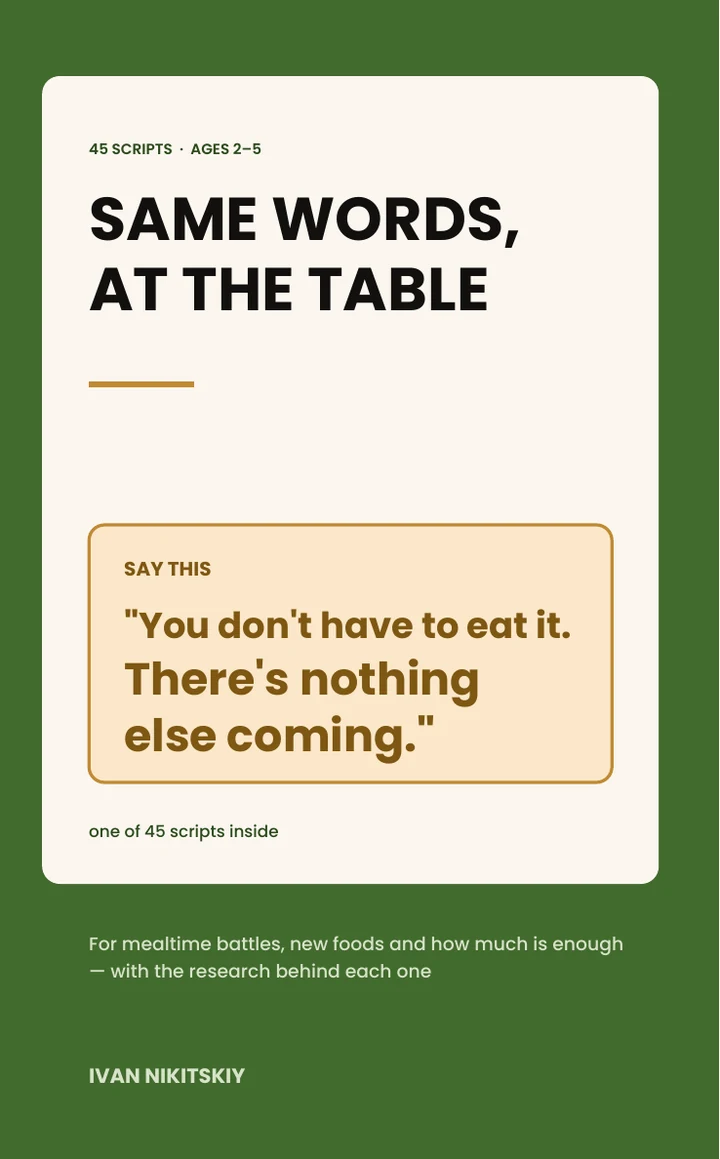
Same Words book
At the Table
Coming to meals, trying food, appetite, sweets and shared family tables.
View the book on Amazon ↗45 situations covered in this book
Won't come to the table, has to be carried over and buckled inAt the Table · Getting to the tableThe meal is ready and everyone is gathering, but one child will not come to the table. What should be a routine move into a chair turns into carrying, buckling, and a difficult start to eating together.→Wants a completely different meal than the rest of the familyAt the Table · Getting to the tableDinner is on the table, yet the child wants something entirely different from the meal everyone else has. The family is ready to eat while a second menu becomes the focus of the evening.→Falls apart right before the meal starts — overtired or overstimulatedAt the Table · Getting to the tableThe child falls apart just as the meal is about to begin. Food is ready and people are sitting down, but tiredness or too much activity has followed them to the table.→Wants to be fed by hand though they can manage the spoon themselvesAt the Table · Getting to the tableThe child can use a spoon, yet asks to be fed by hand. A skill they normally manage gives way to wanting an adult to deliver each bite.→Won't stay in the chair, eats standing up or wanders off mid-biteAt the Table · Getting to the tableThe child eats while standing, leaves the chair between bites, or wanders away with food. The meal continues in fragments instead of keeping everyone around the table.→My child refuses to look at new foodAt the Table · The food they won’t tryA new food appears on the plate, and the child refuses even to look at it. The unfamiliar item occupies the meal before tasting or touching becomes part of the question.→My child will only eat the same three foodsAt the Table · The food they won’t tryThe same three foods are accepted at meal after meal while everything else is refused. Breakfast, lunch, and dinner keep narrowing to a very short familiar list.→Loved a food at a friend's house, refuses the same food at homeAt the Table · The food they won’t tryThe food was welcome at a friend's table, yet the same dish meets an immediate refusal at home. What seemed like a new favorite elsewhere becomes another tense and puzzling family meal.→Watches someone else eat something and tries it for the first timeAt the Table · The food they won’t tryThe child watches someone else eat an unfamiliar food and tries it for the first time. A bite that was previously avoided becomes possible while another person is enjoying it nearby.→Cries at the smell of a new dish before it's even servedAt the Table · The food they won’t tryThe smell of a new dish reaches the child before the food is served, and tears begin. Dinner becomes difficult while the meal is still in the kitchen.→Insists a familiar food "isn't right" today — same brand, same bowlAt the Table · The food they won’t tryA familiar food arrives in the usual brand and bowl, but the child insists something is not right today. The meal looks unchanged to everyone else.→Eats a huge lunch and almost nothing at dinner, same dayAt the Table · How much is enoughThe child eats a large lunch and almost no dinner on the same day. Two meals look completely different, leaving the day's appetite uneven rather than predictable.→Barely eats for two days during a growth plateauAt the Table · How much is enoughFor two days, the child eats very little during a period when growth seems steady. Each lightly touched meal adds to the adults' attention to how much is being eaten.→Inhales food in under two minutes without chewing properlyAt the Table · How much is enoughThe child finishes food in under two minutes, swallowing quickly and barely chewing. The plate empties before the rest of the table has moved far into the meal.→Eats so slowly the meal goes cold before they're halfway throughAt the Table · How much is enoughThe child eats so slowly that the food becomes cold before the halfway point. Everyone else may finish while small bites continue across a long meal.→Two bites in, announces "all done," then asks for food twenty minutes laterAt the Table · How much is enoughAfter two bites, the child declares the meal finished, then asks for food twenty minutes later. Dinner ends early only for hunger to return before the evening has moved on.→Wants seconds and thirds of only the "fun" part of the mealAt the Table · How much is enoughThe child wants second and third servings of the favorite part while leaving the rest untouched. One food expands to fill the meal as the other items remain on the plate.→A grandparent or babysitter gives treats despite the house's rulesAt the Table · Sweets, treats and bargainsA grandparent or babysitter offers treats despite the household's usual rules. The child receives one answer away from the adults who normally decide when sweets appear.→"Just one more cookie" negotiation drags on after the treat is finishedAt the Table · Sweets, treats and bargainsThe treat is finished, but negotiation continues over one more cookie. A small dessert stretches into repeated requests long after the first agreed portion is gone.→A sticker or treat for eating vegetables stops working after a whileAt the Table · Sweets, treats and bargainsA sticker or treat once accompanied eating vegetables, but it no longer changes what the child eats. The promised reward remains while the vegetables stay untouched.→Birthday party or holiday leaves them too wired to eat a real meal afterAt the Table · Sweets, treats and bargainsAfter a birthday party or holiday, the child is too excited and unsettled for a regular meal. Celebration carries into the time when the family expected ordinary eating.→Asks for candy before every single meal, starting the argument earlyAt the Table · Sweets, treats and bargainsThe child asks for candy before every meal, beginning the argument well before food is served. Sweets enter breakfast, lunch, or dinner as the first subject at the table.→Daycare says they eat everything there, but refuse it at homeAt the Table · A different tableDaycare reports that the child eats everything there, while the same foods are refused at home. Two familiar tables seem to produce completely different meals.→Grandparents insist on the "clean plate" rule you don't use at homeAt the Table · A different tableGrandparents expect every item on the plate to be eaten, although the child's home does not use that rule. One family meal now contains two generations of expectations.→Falls apart from hunger while waiting for food at a restaurantAt the Table · A different tableFood is slow to arrive at a restaurant, and the hungry child falls apart while waiting. The family is seated at a table with no meal ready to eat.→A different eating schedule at daycare throws off appetite at homeAt the Table · A different tableDaycare serves meals on a different schedule, and the child's appetite at home shifts around it. The evening table meets a child who ate at another time.→First time at the table with an unfamiliar cuisine at someone else's houseAt the Table · A different tableAt someone else's house, the child sits down to an unfamiliar cuisine for the first time. New smells, dishes, and social expectations arrive together at one table.→My child will not let foods touch on the plateAt the Table · The body at the mealThe child will not allow different foods to touch on the plate. A small overlap between items changes a meal that felt acceptable while each food stayed separate.→Only eats food at one specific temperatureAt the Table · The body at the mealFood is accepted only at one particular temperature. A dish that is too warm or too cool stops being the food the child expected to eat.→Insists on the same bowl, cup or utensil every single mealAt the Table · The body at the mealEvery meal requires the same bowl, cup, or utensil. When the familiar item is missing or unavailable, the object becomes more important than the food beside it.→Eats with hands food that's clearly meant for a fork or spoonAt the Table · The body at the mealThe child uses their hands for food normally eaten with a fork or spoon. The meal reaches their mouth, but not through the table manners adults expected.→Gags on a food they've eaten happily dozens of times beforeAt the Table · The body at the mealA food eaten happily many times suddenly makes the child gag. The familiar bite produces an unfamiliar physical response in the middle of an ordinary meal.→Only eats foods of a certain color, refuses anything "different looking"At the Table · The body at the mealThe child accepts foods of one color and refuses anything that looks different. Appearance creates a boundary across the plate before smell, texture, or taste enters the meal.→One sibling eats almost everything, the other refuses most of itAt the Table · Around the table togetherOne sibling eats nearly everything while the other refuses most foods. Their plates make the difference visible at every shared meal, inviting comparison across the table.→Copies a sibling's refusal to try something newAt the Table · Around the table togetherOne sibling rejects a new food, and the other immediately copies the refusal. A single reaction travels across the table before the second child has tried it.→Notices a parent skipping a food and refuses to eat it eitherAt the Table · Around the table togetherThe child notices a parent leaving one food uneaten and refuses it too. The adult's own plate becomes part of the child's decision about what belongs in the meal.→Wants to help cook or set the table, then loses interest in eatingAt the Table · Around the table togetherThe child eagerly helps cook or set the table, then loses interest when it is time to eat. Participation ends at the point when the prepared meal begins.→Family meals turn into a battleground, so parents start feeding separatelyAt the Table · Around the table togetherFamily meals have become so tense that the adults begin feeding people separately. A table meant for eating together is replaced by different times, places, or plates.→A relative comments on how much — or little — the child eats, in front of themAt the Table · Around the table togetherA relative comments on how much or how little the child eats while the child is listening. Their appetite becomes public conversation during the meal itself.→The list of foods they'll eat keeps shrinking, not just staying narrowAt the Table · When it’s more than a phaseThe child's accepted-food list keeps getting smaller rather than remaining limited but stable. Familiar items disappear one by one from meals the family once relied on.→Gags or chokes on certain textures, not just occasionallyAt the Table · When it’s more than a phaseCertain textures repeatedly make the child gag or choke. The reaction is not an occasional surprise; it returns with the same kinds of food across different meals.→Weight or growth has flattened out between checkupsAt the Table · When it’s more than a phaseBetween health checkups, the child's recorded weight or growth has flattened. Everyday meals now sit beside a visible change on the measurements followed over time.→The same food causes hives, swelling or vomiting more than onceAt the Table · When it’s more than a phaseThe same food is followed by hives, swelling, or vomiting on more than one occasion. A repeated physical reaction links an ordinary ingredient with a frightening family event.→Still only takes purees or a bottle when peers are eating table foodAt the Table · When it’s more than a phaseThe child still relies on purees or a bottle while peers eat regular table food. Their meals remain in an earlier form as other children move into different textures.→Division of responsibility is being done right, and the table is still a battlegroundAt the Table · When it’s more than a phaseThe adults maintain separate roles around serving and eating, yet the table remains a battleground. A carefully structured meal can still feel tense for everyone who sits down.→