Author’s practical guidance
Hugs children who are backing away
Source named in the book: the widening of sympathy (Eisenberg)
Some children are affectionate at full volume, and it is genuinely meant.
Say this now
“Look at her arms. She's saying no with her body.”
Point at the evidence. They will not find it alone.
“Ask first: 'Do you want a hug?' Then wait for the answer.”
The waiting is the hard half. Name it as part of it.
Do this
- Give the sentence, not the ban. They need something to do with the impulse.
- Practice reading faces in books, not in the moment.
- Offer a lower-contact version: high-five, showing a toy, standing nearby.
- Step in fast and gently. The other child should not have to hold the line.
- Praise the asking rather than the hugging, so the skill is what gets noticed.
Avoid this
- "Stop it, nobody likes that!" Attacks a warm impulse instead of aiming it.
- "He's just being loving." True, and it leaves the other child stuck.
- Pulling them off by the arm without saying what to do instead.
If it repeats
If other children start avoiding them, treat it as urgent rather than sweet and work on it before school. If they cannot stop even while coached, and it shows everywhere, mention it at the next check-up.
Why the book suggests this
Some children are affectionate at full volume, and it is genuinely meant. The problem is that reading somebody else's face and acting on it are two separate skills, and the second arrives considerably later than the first.
Research on how sympathy develops finds it grows out of noticing — children help and comfort long before they can explain any of it, and they get better when the noticing is pointed at rather than assumed. Left alone, an over-affectionate child gets avoided by other children, which is a heavy way to learn this.

From this collection
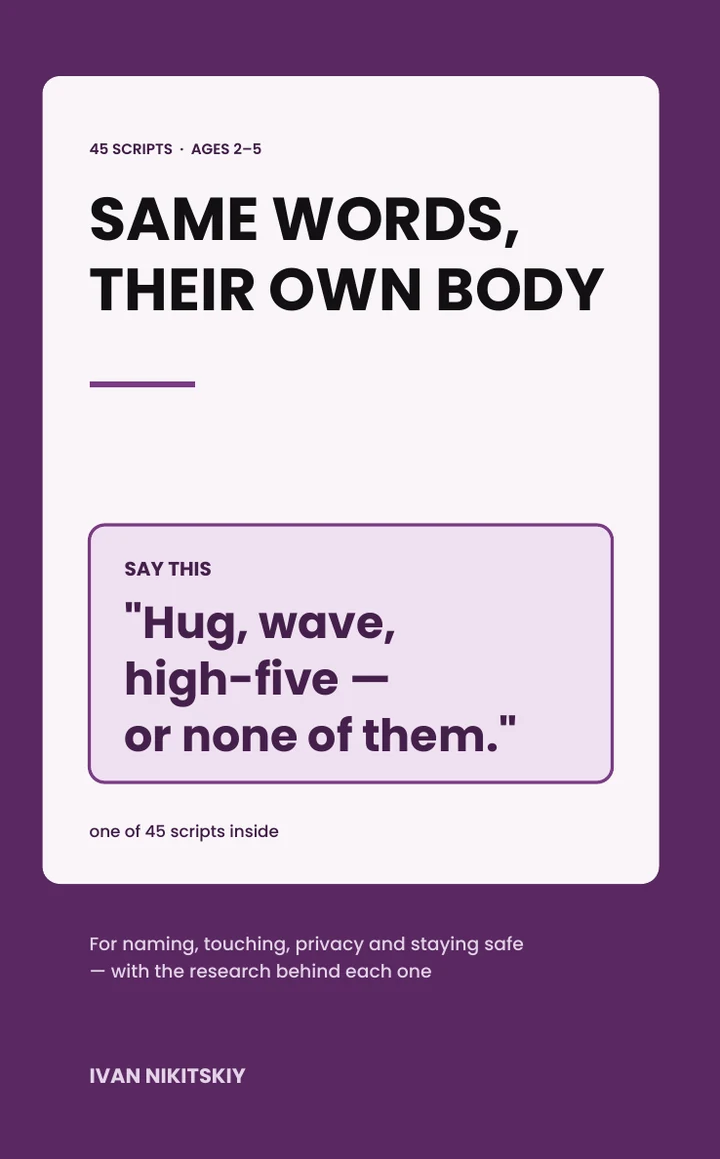
Same Words: Their Own Body
45 prepared situations in this family area.