Author’s practical guidance
"Which one is my real home?"
Source named in the book: research on children in separated families (Emery)
The question sounds philosophical and is not.
Say this now
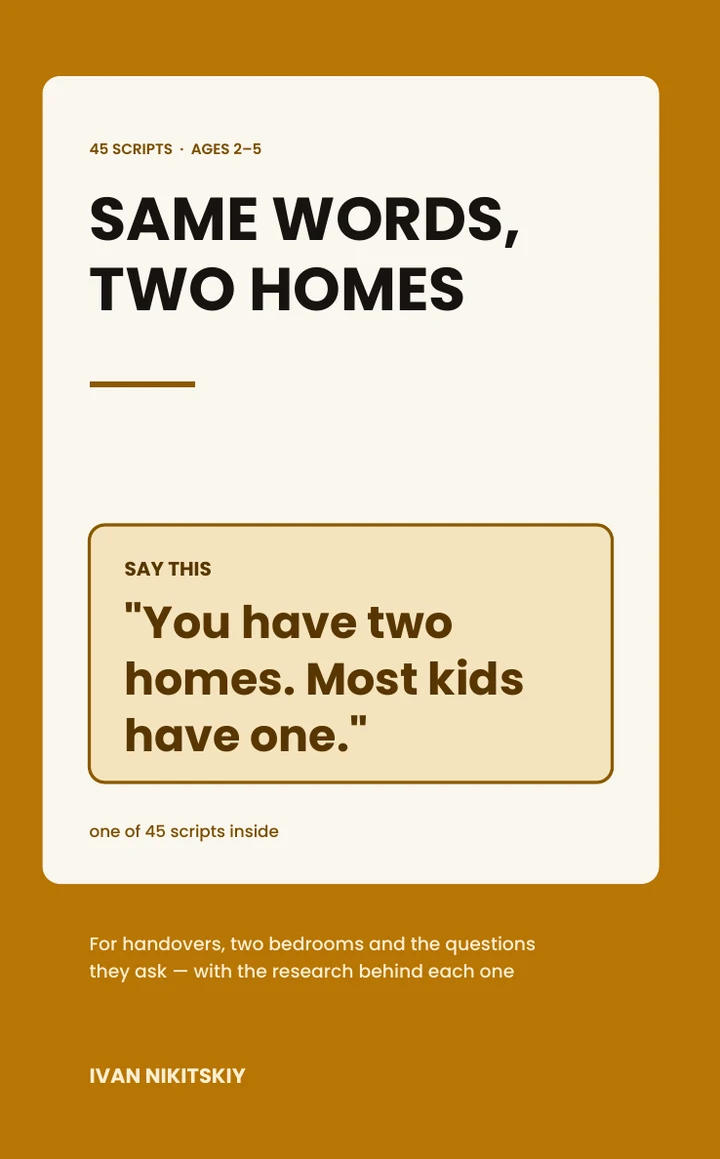
“You have two homes. Most kids have one, you have two.”
States it as a fact about them, not a consolation.
“This is your bed here. You have one at Dad's too.”
Concrete. Beds are what home means at four.
Do this
- Use the word home for both houses in ordinary conversation, not only when asked.
- Say "at Dad's house", never "at Dad's place" — the word does the work.
- Keep a shelf that is theirs in each house, with their things left out.
- Let them keep things at the other house without asking for them back.
- Answer the same way in front of other adults.
Avoid this
- "This one, obviously." Wins the moment and costs them the other house.
- "Wherever you feel at home, sweetheart." Hands a four-year-old a question adults find hard.
- "They're both your home!" said brightly, which reads as avoiding the question.
If it repeats
Asked repeatedly, this is a question about permanence rather than geography. Answer it, then name something about next month: the same daycare, the same birthday, the same people.
Why the book suggests this
The question sounds philosophical and is not. A child of four is asking which address they belong to, because at this age belonging and location are the same idea. Research with separated families finds children handle two homes well and handle ambiguity about them badly.
There is a strong pull to answer with the one you are standing in. That answer solves the evening and creates the problem, because it makes the other house a place they visit rather than a place they live.
Related prepared situations
What happened next?

From this collection
Same Words: Two Homes
45 prepared situations in this family area.