Author’s practical guidance
"I don't want a baby"
Source named in the book: sibling relationships research (Dunn) · Kramer
A child who says this is not predicting how they will behave.
Say this now
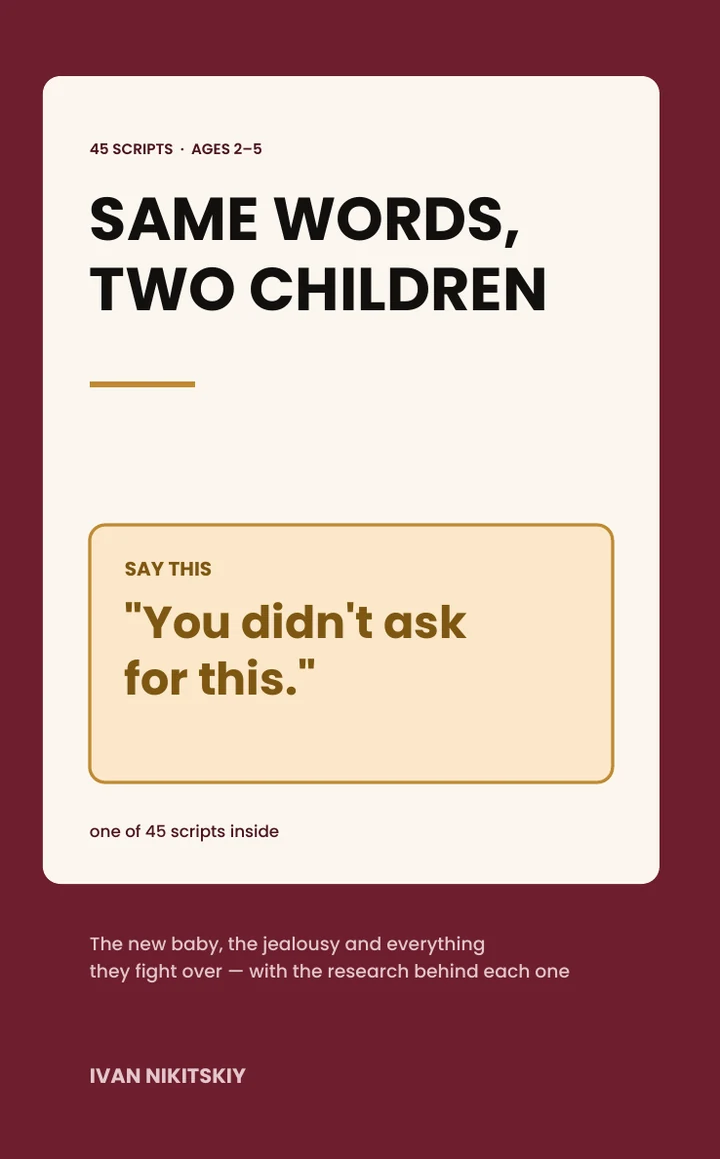
“You didn't ask for this. You are allowed to not want it.”
Permission is the whole content here. It costs nothing and it stops the feeling going underground.
“You can feel that way and I will still keep loving you exactly the same.”
Separate the feeling from the consequence. What they are testing is whether the feeling is safe to have.
Do this
- Accept the sentence without arguing with it.
- Name the loss they are actually pointing at — your time, your lap, your attention.
- Do not make them perform enthusiasm for relatives or for photographs.
- Keep talking about the baby normally afterwards; going quiet confirms the topic is dangerous.
- Say the same thing every time, however often it comes up.
Avoid this
- "Don't say that! You'll love your brother." — a prediction they have no reason to trust.
- "That's a terrible thing to say." — teaches concealment, not affection.
- Listing everything wonderful about siblings — answers an argument nobody made.
If it repeats
Repetition here is a good sign — the child is still bringing it to you rather than hiding it. The one to watch is the child who stops mentioning it while their behavior changes.
Why the book suggests this
A child who says this is not predicting how they will behave. They are reporting, accurately, that nothing about this arrangement was their idea. Everyone around them is visibly delighted, and they are the only one who has noticed there is a cost.
Saying it out loud is the healthier version. The alternative is a child who learns the feeling is forbidden and takes it underground, where it comes out later as a pinch nobody saw.

From this collection
Same Words: Two Children
45 prepared situations in this family area.